Traffic is down but you need more content than ever — Yoast SEO in 2026 Report
Yoast surveyed 59 SEO experts for its 2026 report: traffic is down but worth more, search has moved beyond Google, and you need more content than ever.
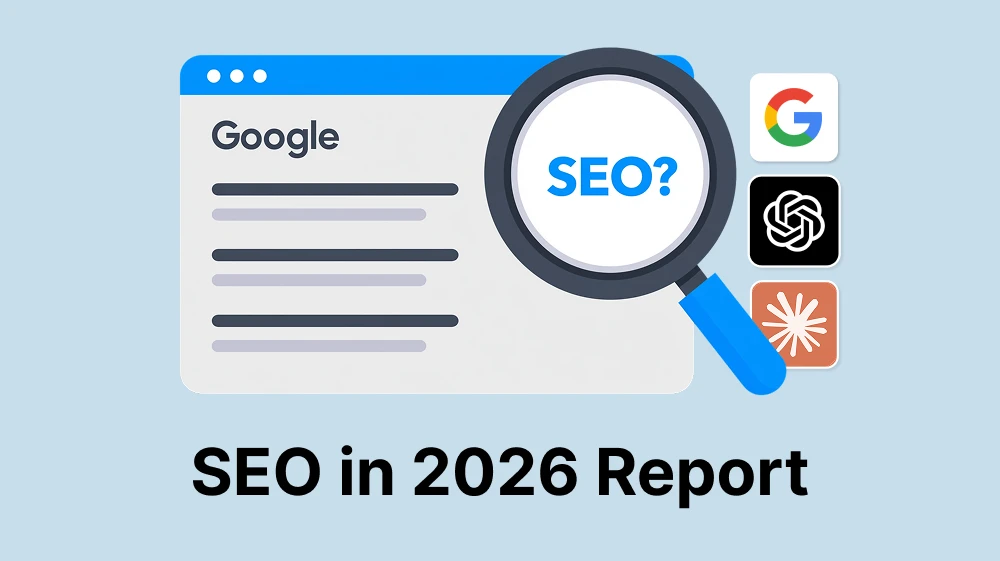
For years, traffic was the headline metric in SEO: more clicks meant more success. In 2026, that equation is breaking.
Yoast just published The Yoast Perspective: SEO in 2026, a report built on a survey of 59 SEO professionals ranging from newcomers to veterans with over a decade of experience, layered with analysis from Yoast's Principal SEOs, Carolyn Shelby and Alex Moss.
TL;DR: Traffic is down, but its value is up. We're getting fewer clicks, but the clicks we do get are more likely to convert. Just publish more and rank higher is no longer a strategy.
SEO is not dying, it is expanding.
Every year someone declares SEO dead but the data says otherwise.
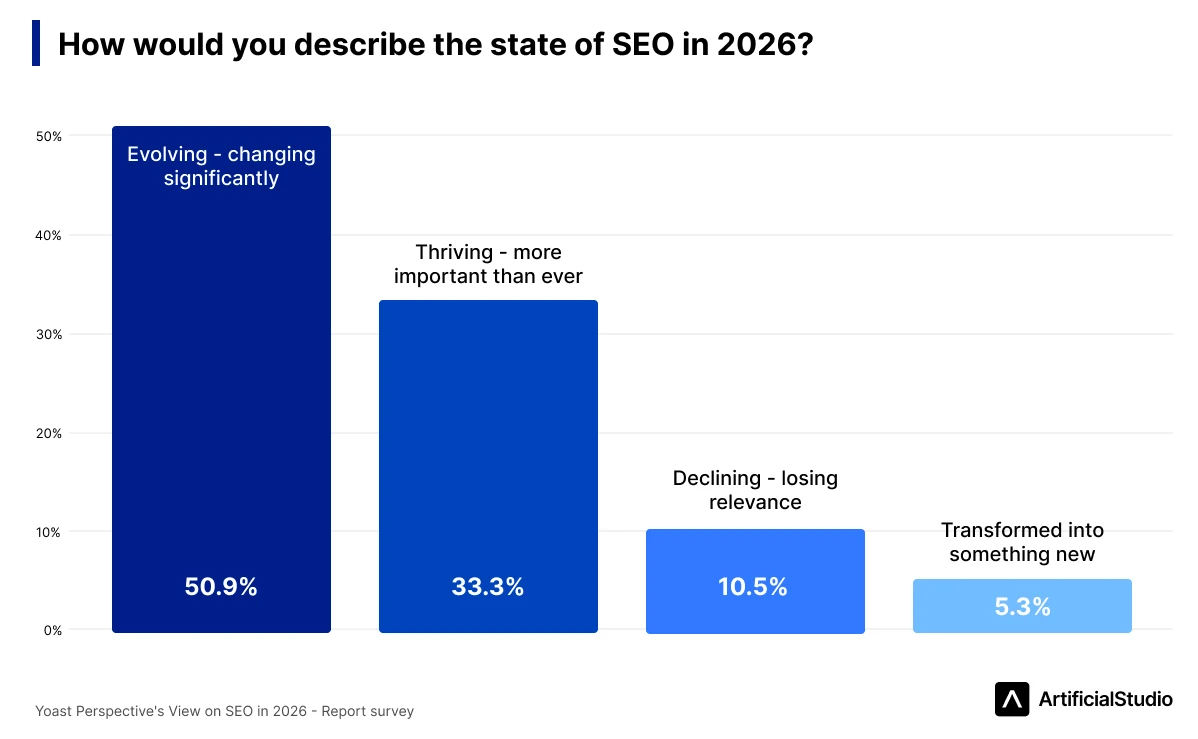
- 50.9% of respondents said SEO it's evolving: still essential, but with changing tactics.
- 33.3% said it's actively thriving, more important than ever.
- Only 10.5% said it's declining.
- 5.3% said it's transformed into something they no longer recognize.
The split gets more interesting when you factor in experience:
- 42% of veterans with over ten years in the field say SEO is thriving
- Just 25% of newcomers with less than three years say SEO is thriving
The people who've lived through multiple algorithm upheavals are the most optimistic — probably because they've learned that "the rules changed" is the one constant in this job. As Yoast frames it:
The 10% who see SEO as "declining" are measuring it by yesterday's rules ("Are my Google rankings stable?"), while the majority understand the real question is now "Are you visible where your audience is searching?"
"Search" doesn't mean Google anymore
When Yoast asked what SEO should even be called in 2026, the top answer wasn't the term we've all used for two decades.
- 39% said it should be renamed "Search Everywhere Optimization"
- 32% wanted to keep "Search Engine Optimization."
The name change is really an admission: people don't just Google anymore.
The report ranks where search actually happens now:
- Traditional search engines first
- Google's AI Overviews
- AI assistants like ChatGPT, Claude, Gemini and Copilot
- YouTube, TikTok and Amazon.
Search has scattered across a dozen surfaces, and each one wants content in its own native format. Yoast's own advice is explicit:
Reuse your content for other platforms like TikTok and YouTube, turn how-to guides into videos, repurpose blog posts into short vertical clips, and give Amazon listings high-quality images. In other words, being visible everywhere means producing for everywhere: the same idea reshaped into a blog post, a short video, a thumbnail, a set of product visuals.
💡 For a small team, that multiplication of formats is the real bottleneck, and it's exactly why creative platforms like Artificial Studio exist — to turn one piece of content into video, images, music and assets for every channel without a separate production team for each.
The strategy shift Yoast describes only works if you can actually make the content the new surfaces demand.
Subscribe to get deep dives on tech and the future of creative work.
LLM optimization is just SEO with stricter standards
If AI search sounds like a whole new discipline you need to learn from scratch, the experts disagree.
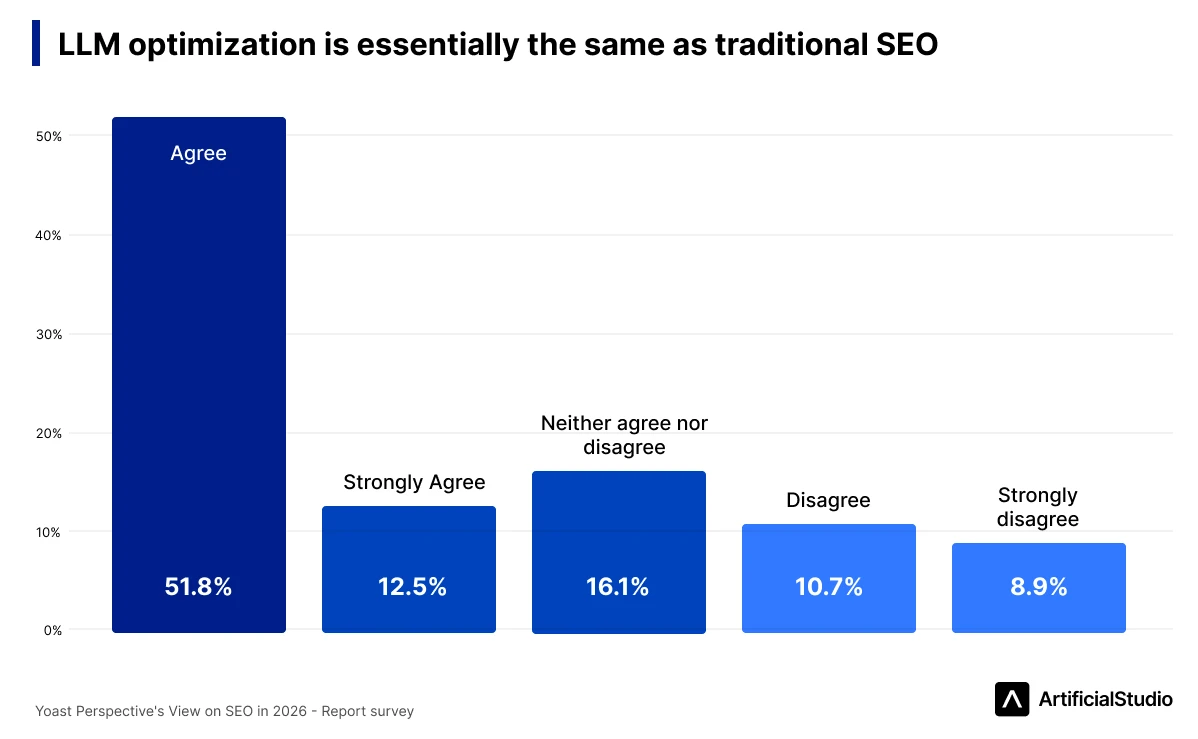
68,8% of respondents agree that optimizing for LLMs is an extension of what they already do, not a separate practice. The fundamentals that make content rank in Google (clarity, structure, relevance, authority) are the same ones that get it cited by an AI. The difference, as the report puts it, is that AI systems have less tolerance for mediocre content.
Adoption is uneven, though:
- 41% of SEOs say they're already actively optimizing for LLMs
- 32% plan to
- 27% haven't started.
And again, experience drives the gap: 74% of veterans are already optimizing for LLMs, versus just 13% of newcomers.
Rankings themselves haven't disappeared as a goal, 52% still consider them equally important as before, but 30% now say rankings matter less than in previous years, because a #1 position means little if an AI Overview answers the question before anyone scrolls.
The metrics are moving from traffic to influence
Since clicks are drying up, what should teams actually measure? The answers show a field mid-transition. Traditional metrics still lead:
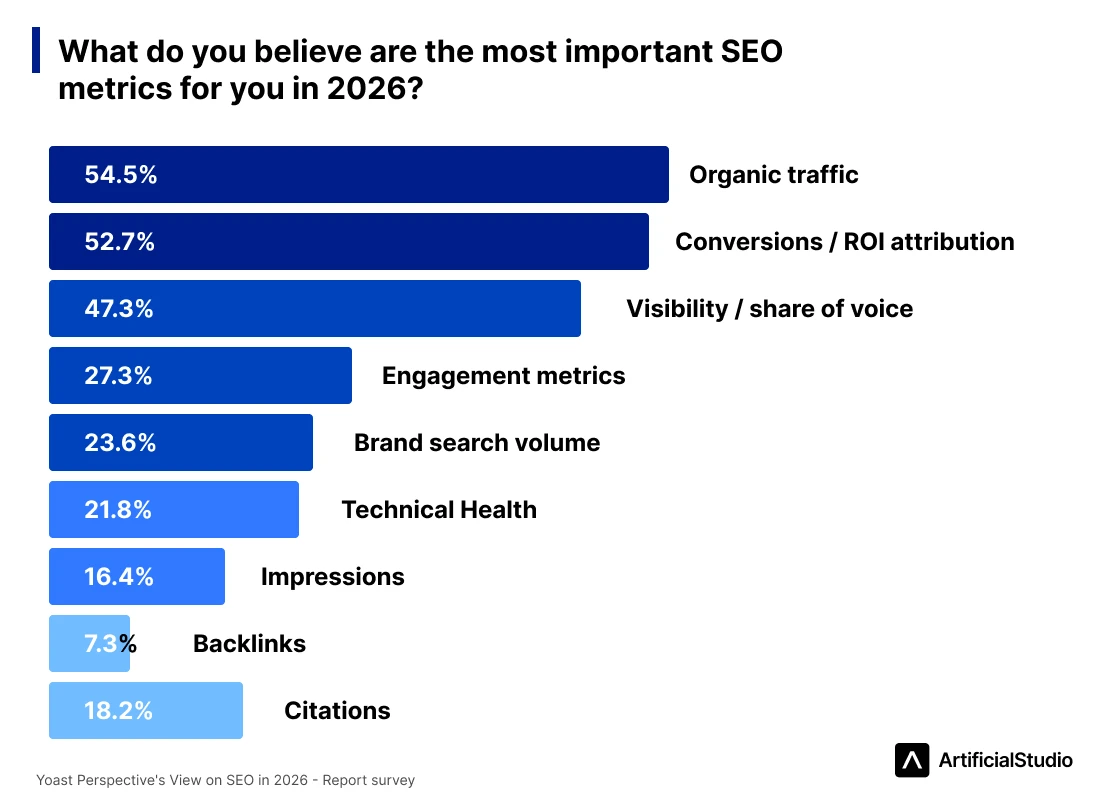
- 54.5% named organic traffic as a top metric
- 52.7% named conversions/ROI attribution, but influence-based metrics are climbing fast right behind them.
- 47.3% now track visibility and share of voice, and 18% track AI citations, mentions from trusted sources that Yoast argues now matter more than backlinks.
The experience divide shows up here too:
- 63% of veterans still lean on organic traffic
- 43% of newer SEOs prioritize conversions and ROI attribution.
Yoast's take is blunt and worth quoting:
"Stop counting visits and start measuring influence. The future of SEO isn't about rankings, but about owning the answer."
What are the challenges:
- The biggest challenge: cited by 49% of respondents, is reducing organic clicks. AI Overviews, zero-click results and chatbots eating into traffic.
- Close behind: 47% struggle to prove ROI in a messy multi-touch, multi-platform world
- And 39% point to content saturation, the fact that AI can now mass-produce "good enough" content at scale, making it harder than ever to stand out.
💡 When everyone can generate a passable article in seconds, distinctiveness (a real point of view, original data, a strong visual identity) becomes the moat.
Stop thinking like an SEO and start thinking like a brand.
When asked how SEOs should think in 2026:
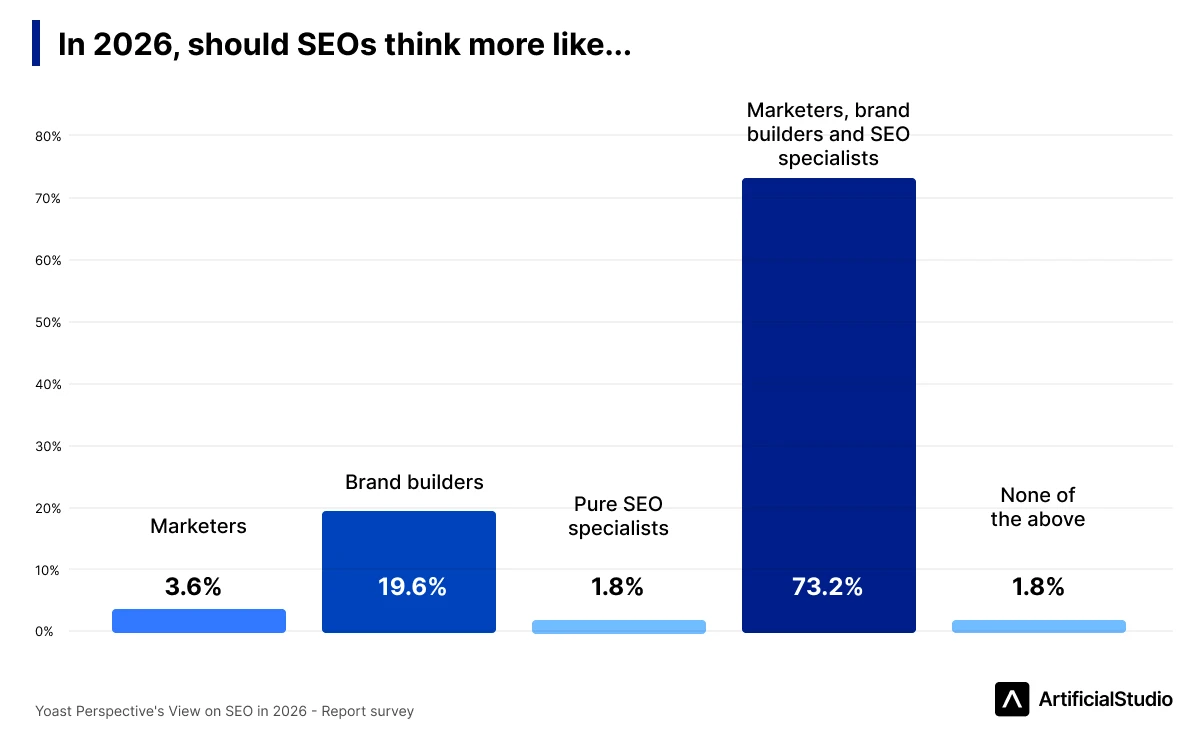
- 73.2% said a mix of marketer, brand builder and SEO specialist — not a pure technician.
- Only 3.6% said "just a marketer"
- Under 2% said "pure SEO specialist." The work no longer lives in a silo.
The logic is straightforward once you connect it to everything above. If AI systems and users increasingly reward authority and trust, then being a recognizable brand is an SEO strategy. Branded search volume, citations from credible sources, and simply being the name people look for by default now feed directly into visibility.
As Yoast puts it, the best SEOs this year will "own the conversation for their brands," not just chase rankings.
Yoast's report lands on a this conclusion:
SEO in 2026 is far from dead: it's bigger than it's ever been.
It now spans traditional search, AI answers, social platforms and voice, and it rewards influence over raw traffic. The fundamentals haven't changed. What's changed is the surface area.
Clicks are down, but the number of places you need to show up — and the number of formats you need to show up in — has multiplied.
The teams that win won't be the ones who publish the most words. They'll be the ones who turn a single strong idea into content for every surface their audience searches, and who measure whether they were chosen, not just seen.
Try it yourself
Start creating with the tools mentioned in this article.