The best AI work doesn’t look like AI — D&AD Creativity Report 2026
AI entries in the D&AD Awards doubled, but generated work won less. What 197 creative leaders reveal for designers, freelancers and agencies in 2026.
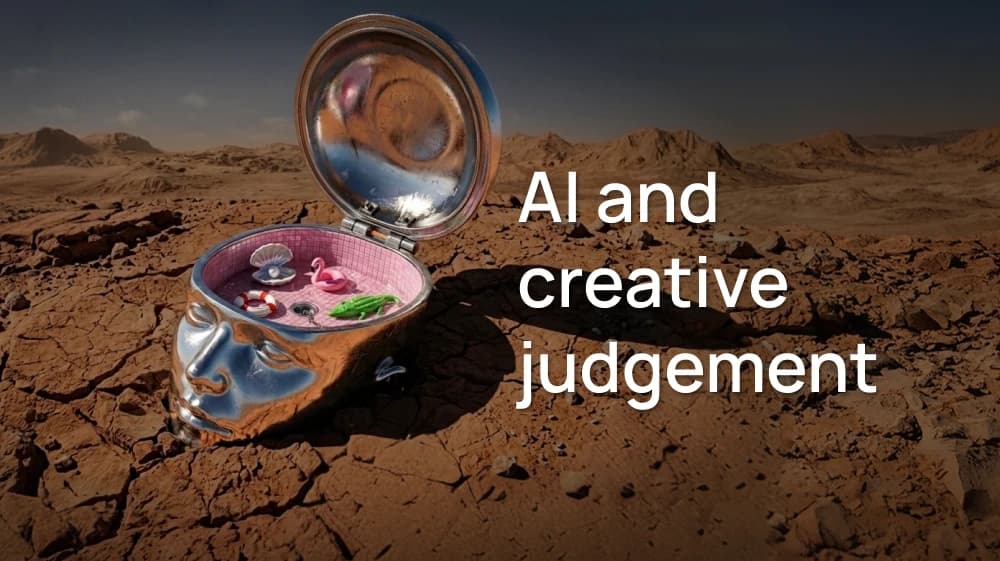
D&AD's AI & Creativity Report 2026 The Cost of the Shortcut gathers the views of 197 creative directors, founders, strategists, producers and lecturers on what's really happening to creative work in the age of AI.
The interviews ran from April to June 2026, about 25 minutes each, 82 hours in total, across 60 cities: London, São Paulo, Sydney, Stockholm, New York, Mumbai, Dubai and more.
D&AD then checked what those people said against the 10,118 entries submitted to the 2026 D&AD Awards, one of the most demanding creative competitions in the world. This year, every entry had to declare whether it used AI, and how. That gives the report evidence of what happens when AI-made work is put in front of a jury.
- In 2025, the industry was arguing about whether AI could be original.
- In 2026 most people have decided it can't. Skill atrophy appeared as a concern that wasn't there a year ago.
The data: using AI didn't hurt your chances. How you used it did
**Entries declaring AI use jumped from 10.7% in 2025 to 27.6% in 2026. **Juries were neutral: work made with AI won Pencils at exactly the same rate as the whole entry pool.
D&AD split AI entries by how the tools were used:
- Generative AI, where the tool makes the material: 56.2% of AI entries, but only 44.7% of AI Pencil winners.
- Assistive AI, where the tool works underneath the idea (research, testing, production, quality control): it made up the difference.
"The shortcut underperforms. The investment wins."
Specialist tools used with intent beat the ubiquitous ones used by default.
Across eight languages, interviewees reached unprompted for the same words to describe default AI output: generic, formulaic, slop, derivative, flat, vanilla, expected.
One associate creative director in Toronto put it precisely:
AI is aggregation, conversion to data, and the mean of that data.
In 2025, researchers tested more than 70 language models on 26,000 real-world queries.
Asked for a metaphor about time, 25 different models converged on two answers. GPT-4o and DeepSeek, built by different companies on opposite sides of the world, described the same product with 81% of their phrasing in common.
When the researchers tweaked parameters to restore diversity, they got gibberish before they got originality. The paper won Best Paper at NeurIPS 2025 and gave the phenomenon a name: the Artificial Hivemind.
D&AD ran its own small demonstration: they prompted models with the word "ketchup". The model returned Heinz almost every time. Forty years of distinctive brand-building became the default.
Defaults belong to whoever is already biggest. If your client isn't Heinz, the model's first answer is someone else's brand.
The industry is responding with "divergence models", built to push output away from the average. On NoveltyBench, which measures how many meaningfully distinct answers a model produces across ten tries, the report cites Springboards' model Flint at 7.47 out of 10, against 1.83 to 3.19 for the frontier models it was tested against.
A model can be pushed away from the average; but nothing pushes it toward a point of view. That still comes from a person 👨💻
As Pip Bingemann, co-founder of Springboards, says in the report:
For a lawyer or an accountant, convergence can be a feature. For a strategist, writer, designer or creative team, it's a bug.
The ownership problem
One of the report stories: A London founder ran a reverse image search on an AI-generated character made for a client and found another company using the same one. The client didn't own anything unique. The team moved to CGI and illustration for final assets, and kept AI only for animation and variation.
If the character, the style or the product shot starts from the model's default, someone else can land on the same default.
The fix isn't to stop using AI. It's to change where the starting point comes from.
→ Build from your own material: your sketches, your photography, your client's real product, a style you defined. This is what we built Concepts for in Artificial Studio: you save a character, object or visual style from your own reference images and reuse it across models and generations.
The model works on top of something that is yours, so the output keeps pointing back to it instead of drifting toward everyone else's average.
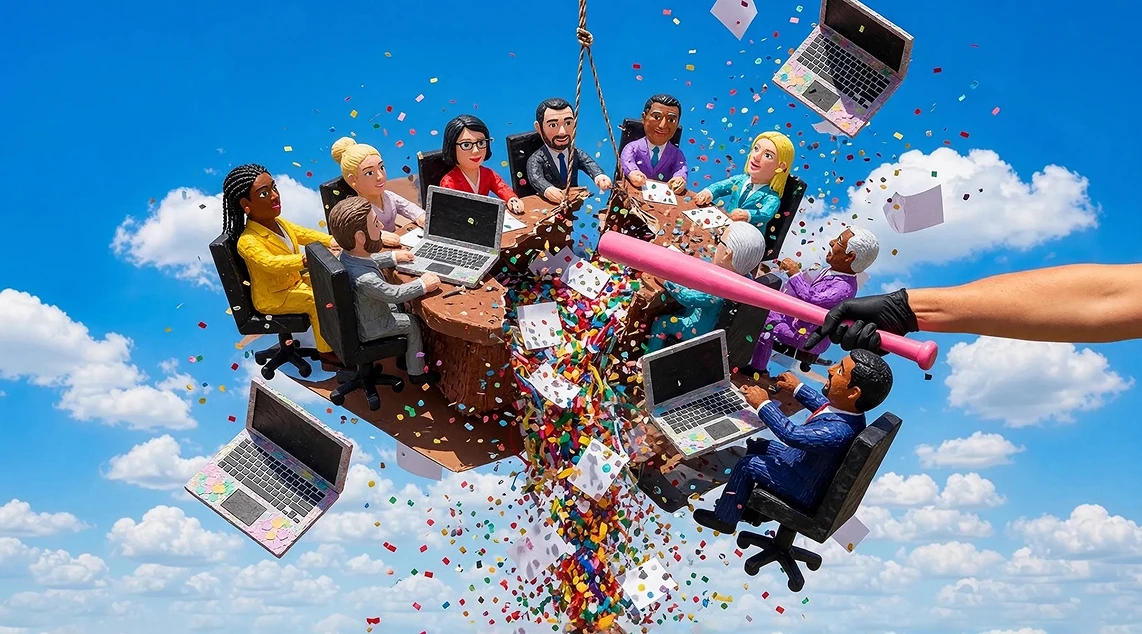
"These tools aren't built for variation. That's something you need to actively build into your prompts. If you don't, it will converge your creativity back to the mean."
— Director of Creative Technology & AI, San Francisco
Faster, not further
Speed is the most cited benefit of AI across the whole study. Research in minutes, mockups before the brief is finished, pitch decks built during the meeting. A copywriter in Philadelphia describes a week of category and competitor research for a fried chicken chain turning into 15 minutes.
The question D&AD asks is what happened to that time. Most teams spent it on more output: faster briefs, tighter approval cycles, more deliverables. Few spent it on going somewhere new.
The award-winning work points the other way. In the cases the report highlights, AI is invisible in the final piece:
- Caption with Intention (Chicago Hearing Society) used Whisper for transcript alignment and emotion recognition to animate captions with the emotional weight of each line.
- Build Your Own Super Bowl Commercial (Uber Eats) used custom AI quality control on more than a thousand edit outputs, flagging problems for human review. Every decision was still made by a person.
- PainVisible turned clinical data into a visual language for people who struggle to describe pain.
In each one, AI handles the mechanical layer so people can spend their time on the idea.
In D&AD's words:
"If the work reaches the same destination faster but unchanged, you have not used the tool. You have just arrived earlier."
If you want to go deeper into this, our article Everything that scales is now worth less — State of Marketing 2026 looks at the same pressure from the marketing side: more content expected, less value per piece.
Subscribe to get deep dives on tech and the future of creative work.
The pricing gap: you're selling judgement and billing for hours
This section is for every freelancer and agency owner.
Around 70% of participants report no change in their fees or pricing models. At the same time, speed is the number one benefit of AI. If you still price by hours and deliverables, and AI made both faster and cheaper, the efficiency gain went straight to your client.
People across the study say they sell:
- Judgement.
- Taste.
- Strategic thinking.
Their invoices still say they sell time.
Some are already changing the model:
- A nine-person studio in Bucharest sees mid and high-tier clients coming back to human-led work, at a premium, after a period of testing AI.
- A Sydney Executive Creative Director lists token costs as a separate line in project budgets.
- A London ECD turned their AI process into a product, selling structured playbooks as a service.
- A Chief Content Officer in Turin argues the model has to move "from labour-based to idea/IP-based".
In a Klaviyo survey of 8,000 consumers across eight countries, when people could tell content was AI-generated, 32% trusted the brand less and only 7% trusted it more. Even among people who actively use and like AI, 39% would trust a brand less for using AI-generated content.
Visible, generic AI costs your client trust. Work that carries a point of view is worth paying for. The agencies charging a premium for it are pricing that difference, everyone else is giving it away.
The work was the training
The first tasks AI is taking over are layouts, drafts, mockups, research and iterations. That’s exactly the work that turned juniors into seniors.
- In UK agencies, the share of employees aged 25 and under fell 19.2% year-on-year, to 11.8% of the sector (down from 17.4% three years ago), according to the IPA Agency Census.
- In the US, the share of advertising and PR jobs held by people aged 20 to 24 fell from 10.5% in 2019 to 6.5% in 2024.
More than half of agencies have slowed or paused entry-level hiring.
The report is honest that AI isn't the only cause: only 8% of UK agencies directly attribute headcount cuts to AI; holding-group consolidation and margin pressure explain a lot of it. The juniors not hired in 2025 are the missing seniors of 2031.
A 2025 Microsoft and Carnegie Mellon study found heavier AI reliance reduced critical thinking. MIT Media Lab, recording the brain activity of 54 essay writers, called it cognitive debt: the effort you skip now gets repaid later, in weaker recall and thinner ideas. And research consistently shows AI boosts productivity most for people who already have strong judgement and craft. If you remove the years that build it, there's nothing for the tool to amplify.
If you're a solo designer or freelancer, there's no art director forcing friction into your process. You have to keep it yourself: do the first sketches by hand, write down why you rejected a direction, critique the output before you accept it.
If you want to read more on how designers can position themselves here, see Your taste won't save you from AI. How to think like a strategist.
There's also a cost problem. KPMG found:
Only 26% of senior executives have real-time visibility into what their AI systems cost 💸
D&AD suggests keeping three ledgers:
- Time: how AI is changing the shape of the work, and where decisions still need people.
- Tools: which are approved, which aren't, and why.
- Tokens: the compute costs piling up across teams.
Most creative organisations keep none of the three. For a small studio, this doesn't need to be a committee, a one-page document will do: where you use AI, where you don't, which tools, who signs off, and what it costs per project. Review it every six months.
Six creators who used AI to make amazing work:
- Ash Koosha made Dreams of Violets, a 75-minute AI docudrama, from his home in London for about $2,000. Tribeca accepted it in June, the first AI-generated live-action feature taken by a major festival.
- Wenhui Lim (Nice Aunties) was an architect before building the "Auntieverse", since shown at the Louisiana Museum, Paris Photo, Christie's and the Grand Palais.
- Kavan Cardoza (Kavan the Kid) built a fantasy epic from his desk, no crew or studio. Magnific bought the rights to the first season. "I'm using this machine, but I'm still the author behind the work."
- Alex Naghavi spent 17 years as a creative director before moving into film in 2023, and has since won festival awards that most directors chase for a career.
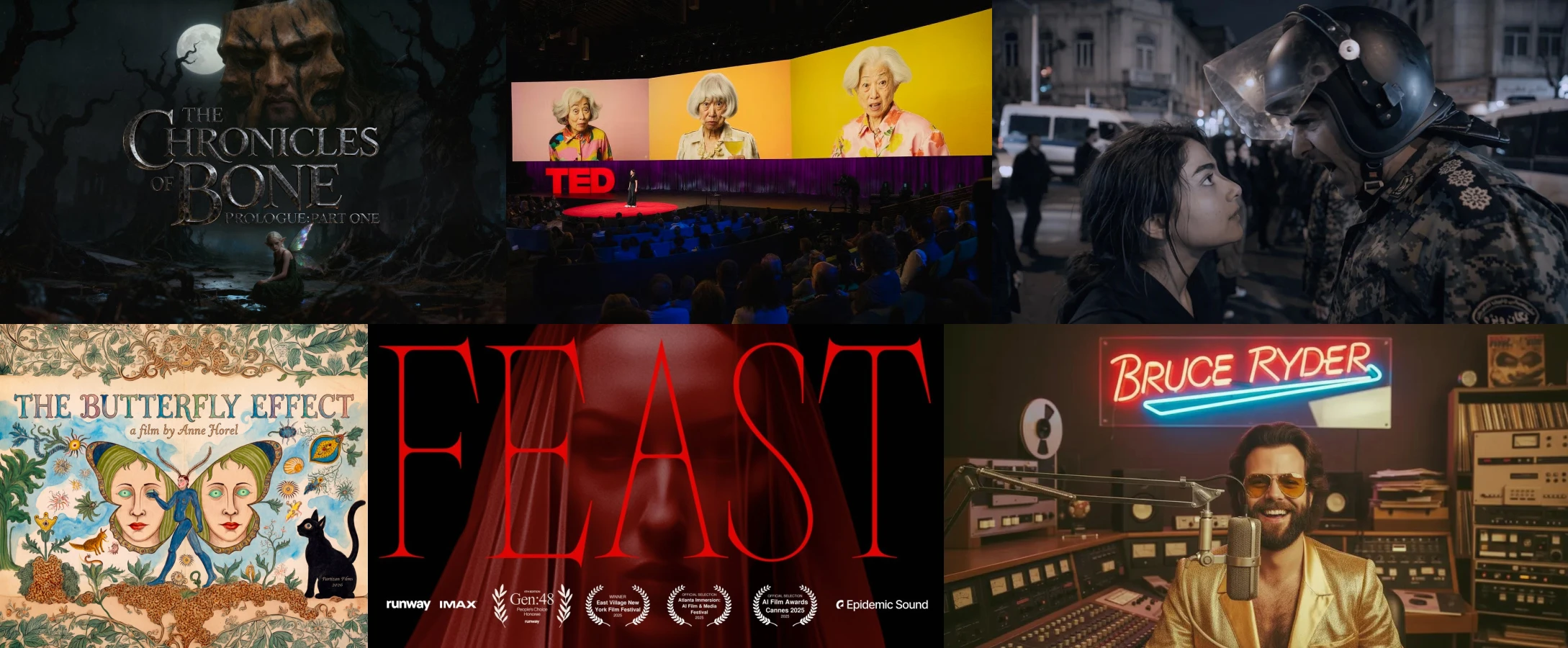
None of them handed the idea to the model. Each brought a format, a world or a point of view, and used AI to produce what one person couldn't have produced alone. That's the same split the Awards data shows: AI under the idea, not instead of it.
D&AD ends with two models that are taking shape at the same time.
The Shortcut Model uses AI to cut the parts of the process that cost money: research, concepting, revisions. Junior tasks go first. Pricing doesn't change, so the savings go to the client.
The Judgement Model treats AI as infrastructure, not strategy. Saved time is reinvested, so the work still carries a point of view. Fees follow judgement, not hours. There's a written position on ethics, the cost of the tools is known, and the people setting direction have actually used them.
Five things to take from this
→ Treat the default as a draft, not a deliverable 🎯 If the result could come from anyone using the same prompt, it isn't finished. Start from your own references, push the output away from the first answer, and keep the directions you rejected: that's where the creative decision is visible.
→ Use AI underneath the idea. 🧱 Research, variations, resizing, quality control, versioning per platform. That's where the award data says AI pays off. Be more sceptical when it's the source of the idea itself.
→ Spend the time AI gives you on thinking, not volume. ⏱️ If research that took a week now takes 15 minutes, the time you saved belongs to depth, not to ten more deliverables at the same fee.
→ Change how you price before clients change it for you. 💰 Sell decisions that produce outcomes, not hours that produce files. Put that language in proposals and contracts now. If you use AI in production, consider showing tool costs as a separate line.
→ Write your AI position on one page. 📝 Where you use it, where you don't, which tools, who's accountable, what it costs.
Try it yourself. Start creating with the tools mentioned in this article: open Artificial Studio.
Try it yourself
Start creating with the tools mentioned in this article.