Everything that scales is now worth less — State of Marketing 2026
HubSpot surveyed 1,500+ marketers for its State of Marketing 2026 report. 83% are expected to produce more content, but the formats that actually pay are the hardest to make.

These three numbers define the problem of the year:
- 80% of marketers now use AI for content creation.
- 75% use it for media production.
- And 52% believe AI has made content so easy to create that it is less effective overall.
The tool that solved the production problem also destroyed the value of what it produces. Now thate everyone has it, the market is saturated with the output ↓

HubSpot surveyed 1,505 marketers across North America, Europe, Asia and Australia at the end of 2025. What follows is what the data says about where content value actually moved, and what to do about it.
Attention is shifting somewhere else.
- 83% of marketers say that with the advent of AI, they are expected to produce more content than ever before.
- 80% of teams plan to maintain or increase their content budgets in 2026.
But 53% of marketers say they struggle to differentiate their content in an AI-saturated market. And when HubSpot asked marketers to name their single biggest content challenge, the answer wasn't producing content or finding budget for it. It was creating content that gets engagement.
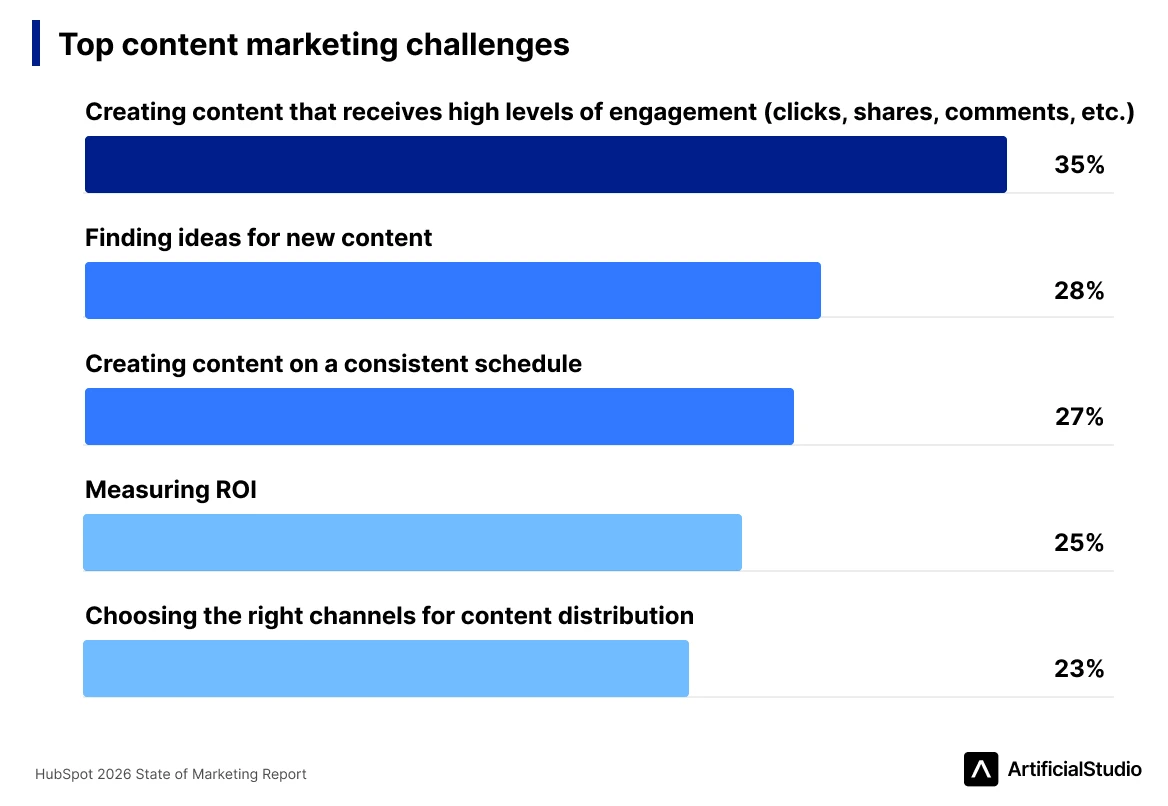
Volume and ideas are barely the problem anymore. Instead the problem is that the content gets made and then nothing happens.
Kieran Flanagan, HubSpot's SVP of Marketing, AI & GTM, put the mechanism plainly in the report: most AI-generated content is average, consumers are learning to tune it out, and attention is migrating to spaces AI hasn't flooded yet: newsletters, podcasts, YouTube.
Notice what newsletters, podcasts or YouTube have in common: none of them is text.
Every format that gained ROI this year is audiovisual
Short-form video was the most-used content format of 2025 and the highest-ROI format by a wide margin. For 2026, 30% of teams say it's where they'll invest most, more than double the next format.
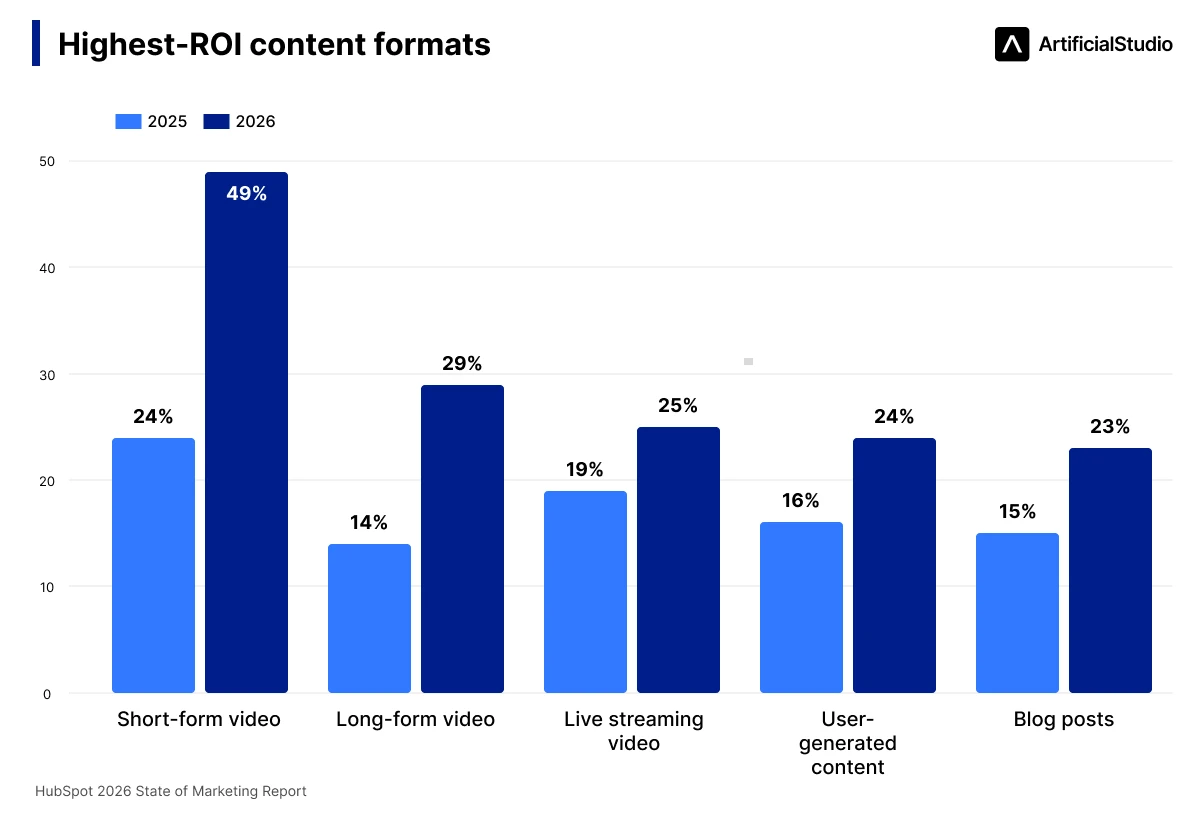
Not only long-form video grew, also live streaming did, and user-generated content. Blog posts grew too, the written word is not dead, and small businesses are 23% more likely than average to see ROI from blogs.
But four of the top five growth formats are things you have to make, not write. The five social platforms marketers plan to invest in most for 2026: TikTok, Instagram, Facebook, YouTube, Twitter/X — all support short-form video. TikTok usage grew 62% year over year, the largest gain of any channel.
The formats that return the most are the ones that require a camera, an editor, a voice, a designer, or all four. AI made the cheap thing cheaper and left the expensive thing expensive.
Repurposing content
75% of marketers now use five or more distinct marketing channels. Only 6% run on one or two.
And 94% of teams diversified their channels last year. The most effective change was moving from broad platforms to niche communities — smaller audiences, higher-quality connections. Which is correct strategy and a production nightmare at the same time, because a niche community rewards content made for it, not a repost.
That's why "repurposing content across various channels" sits in the top five trends teams are currently exploring, right alongside using AI for personalization and automating processes.
All of this makes it harder to produce a single marketing campaign: a hero asset, cut for Reels, cut for TikTok, cut vertical for Shorts, a thumbnail, a set of stills, a voiceover, captions, and a localized version if you sell in more than one language. That can be easily 15 assets.
Also, 73% of marketers say their budgets are more heavily scrutinized than they used to be. They're asked to justify more, but headcount stays the same.
Subscribe to get deep dives on tech and the future of creative work.
The personalization of channels is mandatory
93% of marketers report that personalization improves leads or purchases. And yet only 13% of teams hyper-personalize based on data or lookalike audiences. Only 14% segment or personalize at least half of their content. The most common approach is still putting a first name in an email.
When you rank channels by ROI, you get almost exactly the same ranking as when you rank them by how well they support personalization.
Social shopping tools top the personalization list at 29%. Website/SEO, paid social and email follow.
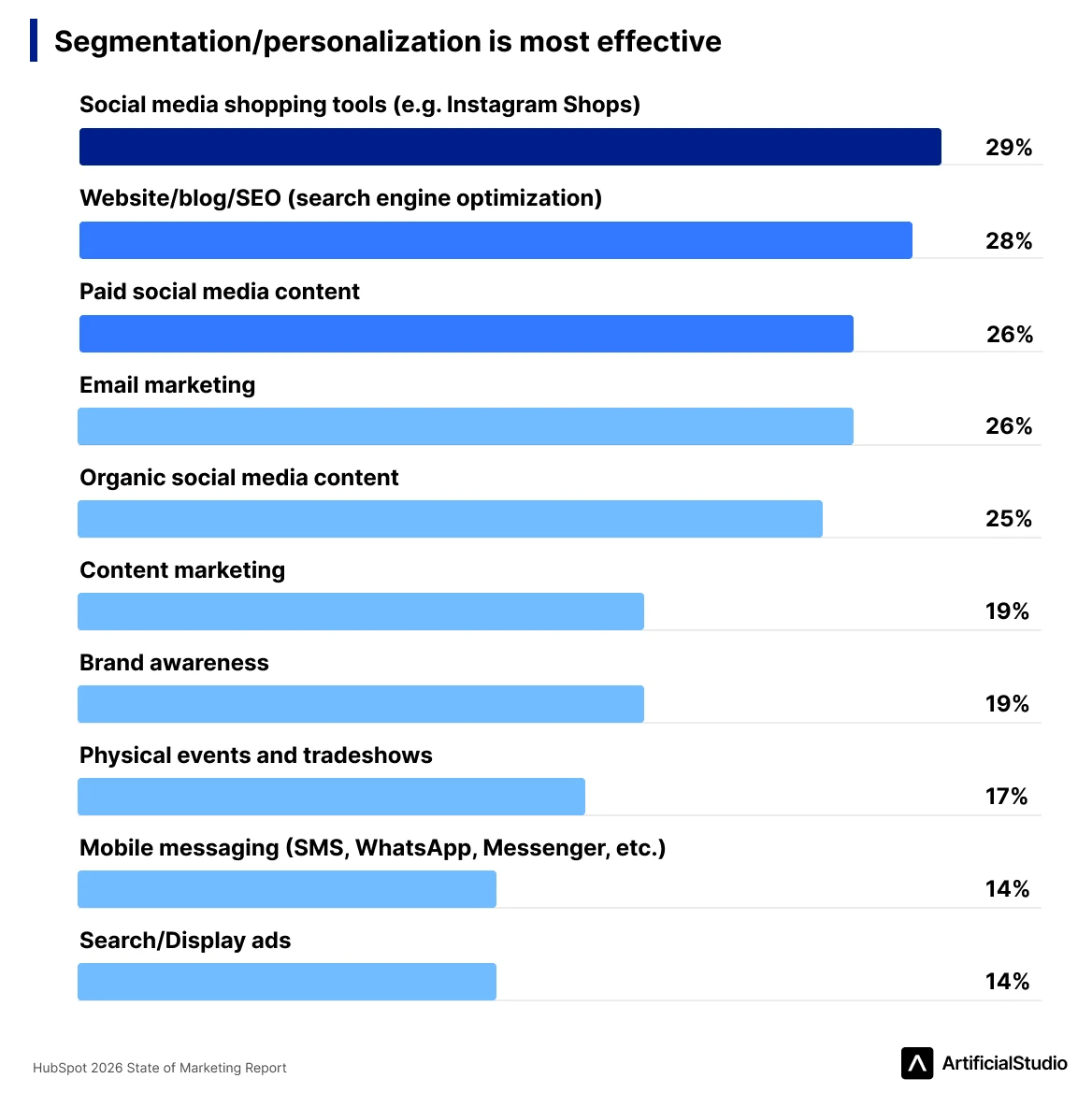
The report attributes the gap mostly to data, it's true that fewer than half of marketers know their customers' shopping habits, and only 16% know their pain points.
But data is only half of it. Knowing that you should show a different creative to four segments is worthless if producing four versions of the creative costs four times as much. Plenty of teams have the segments, but don't have a way to make forty assets instead of ten without hiring.
What creative teams are doing differently
61% of marketers agree that expressing your taste and brand point of view is a necessary component of a successful AI strategy. 63% say they need more unique, human-centered content to stand out.
And 40% of teams still haven't clearly defined or documented their brand's unique value proposition.
The most important question isn't who has AI because everyone has AI. It's who has something specific to say before they generate anything with it. HubSpot's CMO Kipp Bodnar reduces it to four words in the report:
More important than AI is good taste.
The highest-ROI brand investment, by the way, is brand awareness campaigns (29%), followed by aligning customer experience with brand promises (23%) and developing a messaging framework (20%). Visual identity systems come in at 11%, which is not an argument against design, but an argument that a beautiful system without a point of view underperforms a clear point of view executed plainly.
A working plan for 2026 and 2027
-
Write down your POV before you produce anything. If you're in the 40% without a documented UVP, that's the highest-leverage afternoon of your quarter. Everything downstream (every prompt, brief, every cut) inherits it or contradicts it.
-
Rebalance toward video, and be honest about capacity. If short-form video is where your ROI is and you're publishing two pieces a month, the constraint is production, not strategy. Count how many finished assets one campaign actually requires across your five to eight channels, then look at what your team can realistically ship. Generating video, animating stills, adding voiceover and translating for each market are all things a complete AI production stack can absorb.
-
Personalize where the ROI already is. Start with the channels that top both rankings (social shopping, SEO, paid social, email) and produce variants for your two or three highest-value segments. If visual consistency across those variants is the bottleneck, generating each one from a set of brand reference images removes the problem that usually kills segmented production.
-
Consolidate before you scale. Most teams accumulated one AI subscription per format — one for images, another for video, for voice, and a final one for editing. Every one of them has its own login, credit system and output style, which is exactly how brand consistency dies across eight channels. Before you add production volume, think whether that stack should be one stack.
Try it yourself
Start creating with the tools mentioned in this article.