Teams' problem isn't AI, it's their tools — AI in sales report 2026
Apollo's 2026 AI in Sales & Go-To-Market Survey: 97% of teams use AI, 74% juggle 2–5 tools, and only 4.4% trust it without review. Why 2026 is the year of consolidation.
97% of go-to-market teams have adopted AI. But adoption is not even a question anymore.
Apollo's 2026 AI in Sales & Go-to-Market brand new Survey is one of the most useful pieces of research to come out this year.
Conducted in June 2026 with 328 GTM professionals (customers and non-customers), it's the first edition of a research series designed to benchmark how AI adoption is actually maturing across teams.
Everyone has adopted AI, but almost nobody has optimized it ⚙️
- 36.3% of surveyed teams described themselves as "implemented but not optimized" in their AI journey.
- Another 31.1% are still just exploring.
- Only 17.4% consider their AI use fully operational, standardized and measured.
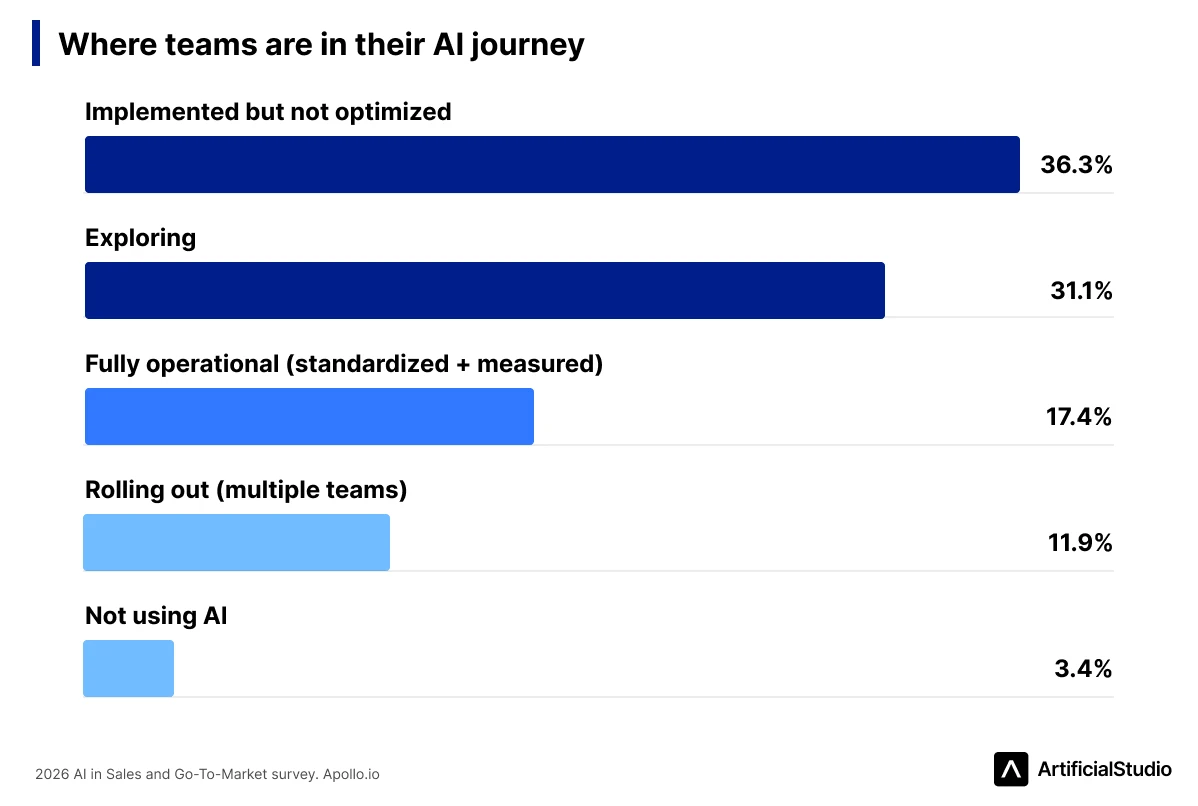
It points to a gap between having AI and getting value from it in a repeatable way.
Artificial Intelligence is so new that teams don't know where to start and can't even agree on what the concepts mean 🤔. For example, Apollo asked teams what "agentic AI" means, and these were the answers:
- 30.4% said autonomous agents that take actions across tools
- 30.1% said multi-step workflows with AI
- The rest split between direct LLM chat, single-step features, and simply not being sure.
The real bottleneck is the tool sprawl and not the AI adoption.
74% of teams report running somewhere between two and five different tools today.
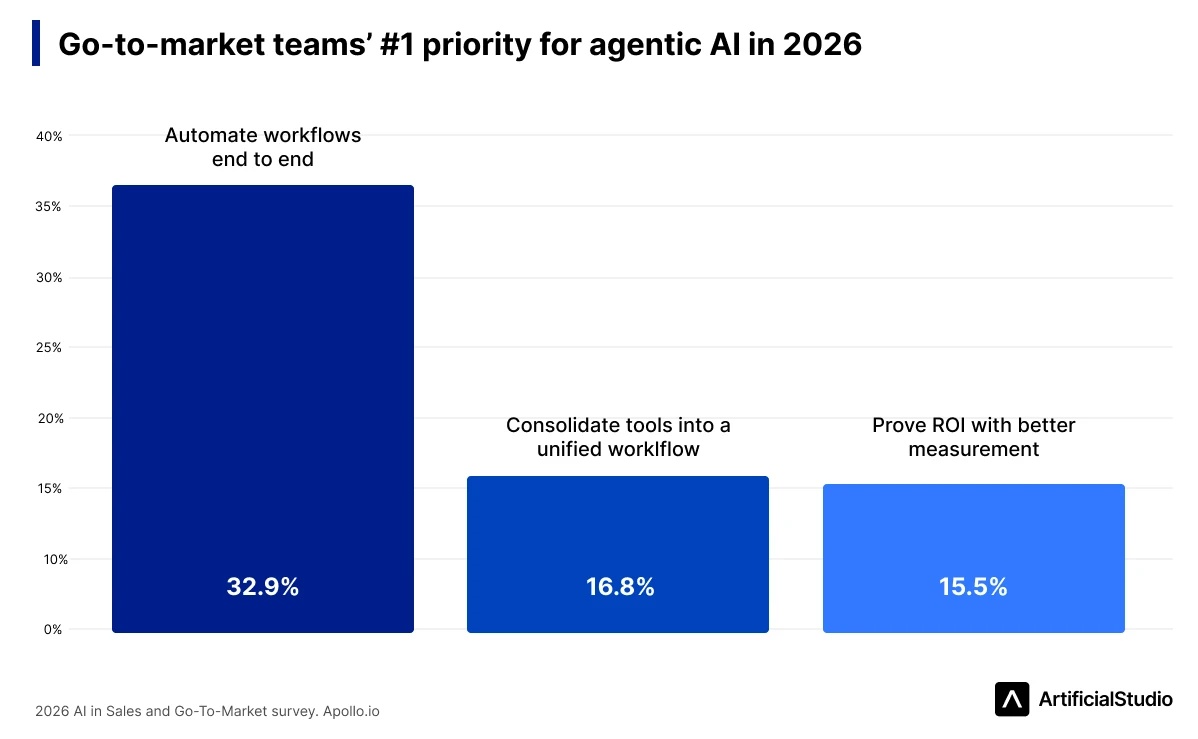
When Apollo asked what the #1 priority for agentic AI in 2026 is, the top answer of course wasn't "add more AI", it was:
- "Automate workflows end-to-end" (32.9%)
- "Consolidate tools into a unified workflow" (16.8%).
You can see the friction in how work actually flows, teams are almost evenly split on where a task even begins: 32% start in a SaaS tool and bring an LLM in to refine the work, while 31% start in an LLM and push the output back into their software afterward.
Apollo calls that near-even split "a sign of friction": teams manually stitching 🚧 two disconnected surfaces together, copying context from one tool into another and pasting the result back.
Any team that has spent 2026 collecting AI tools instead of connecting them recognizes this exact problem. The answer the data points to isn't a better individual tool, it's fewer and more capable tools that work as one connected motion.
It's the same logic behind consolidating a fragmented creative stack (image, video, audio and 3D) into a single AI platform instead of paying for and switching between four or five separate subscriptions. The friction Apollo measured in the sales stack is the same friction creative and marketing teams feel every day, and the fix is structural, not additive.
Subscribe to get deep dives on tech and the future of creative work.
AI earns its keep fast but only with a human in the loop.
AI pays off very quickly. 85% of teams say they're already seeing benefits 💰. Nearly a third saw measurable results in under 30 days, and more than half saw them within two months.
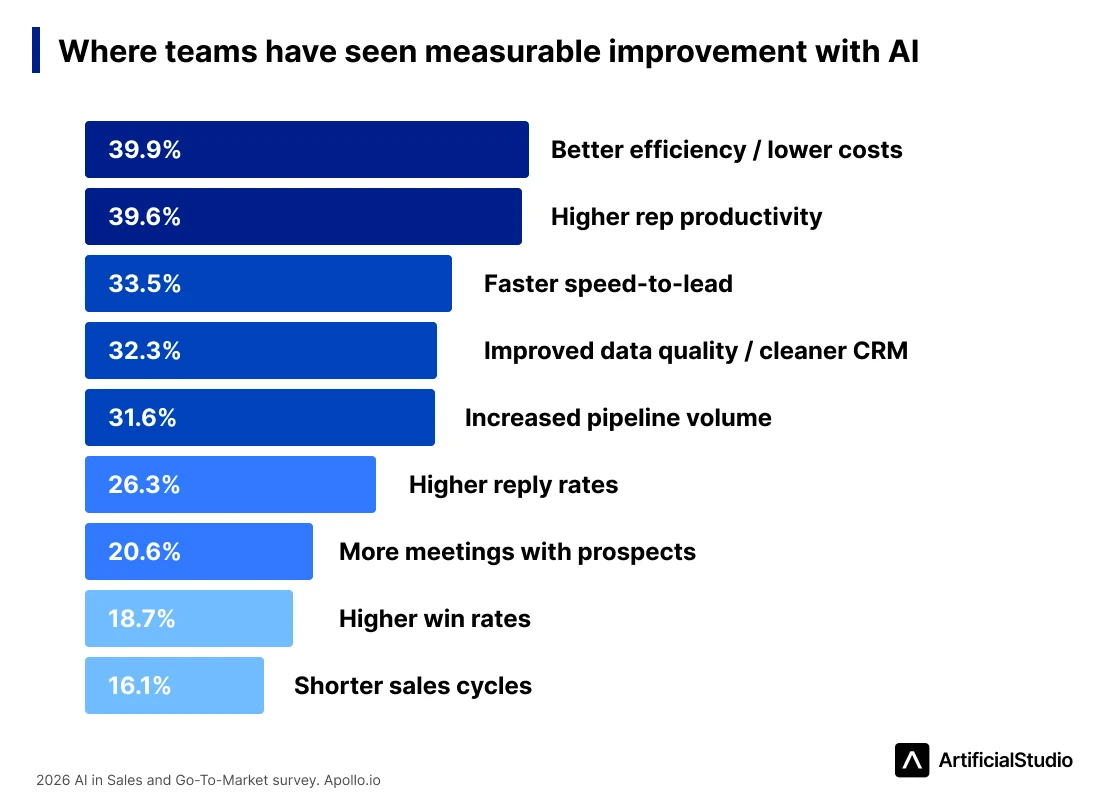
Where those benefits show up is telling:
- Better efficiency and lower costs (39.9%) the top improvements.
- Higher rep productivity (39.6%). clearing away the repetitive tasks.
Nearly 90% of teams feel at least moderately confident that AI will keep delivering value over the next year, and just 2.8% aren't confident at all.
But only 4.4% of teams fully trust AI generated outputs without review 🔍
More than half do at least some checking, and more than a third say outputs still require heavy human review before they'll rely on them. It's a healthy split that teams have built into their workflows: automate the repetitive steps, keep a human reviewing anything that touches a customer or a deal.
Interestingly, the biggest barrier depends on team size. Larger teams 🏢 struggle less with trust and more with infrastructure, 57.1% of enterprise teams cite tool silos and integration complexity as their main obstacle. Smaller teams 👥 have the opposite mix: simpler tooling, but a harder time trusting AI enough to fully rely on it, with 44.9% of the smallest teams naming low trust as their barrier.
AI replaces workflows, not people
Only 6% of sales and marketing leaders think AI could replace someone on their team today.
That reframes what AI is actually for in the eyes of the people using it. It's not being deployed to shrink teams. instead it takes over the parts of the job that used to eat the day (finding, researching, data cleanup, first drafts) so people spend more time on the work only they can do.
In sales, that's actually selling. For creative and marketing teams, it's about owning the direction, taste, and craft, and leaving the repetitive work to platforms like Artificial Studio.
The teams that win the next year won't be the ones with the most AI tools. Instead, they'll be the ones who stopped adding and started connecting, trading a drawer full of subscriptions for one platform that does the work end to end.
Try it yourself
Start creating with the tools mentioned in this article.