How to stop AI from killing your critical thinking
AI can quietly erode your creativity, critical thinking and memory. What the research shows and how to use AI without outsourcing your mind.
This is a normal workday: you ask AI to summarize the inbox full of emails, AI drafts the response. You need to write a report, but the blank page is intimidating, so you drop in a few documents and let AI produce a first draft. You've got data to analyze, a deck to build, a prototype to ship. All day AI. I do that too.
Writer's block is an outdated idea. It used to mean staring at a blank page, now you stare at a page AI already wrote for you and decide whether you agree.
As researcher Advait Sarkar put it in a recent talk, we've become:
"Professional validators of a robot's opinions"
Over the last two years, a wave of research has started measuring what happens to human thinking when we hand the cognitive work to AI. The findings are consistent.
The creativity paradox: better alone, worse together
A 2024 study published in Science Advances, "Generative AI enhances individual creativity but reduces the collective diversity of novel content" said:
Writers using AI assistance produced work that was, individually, rated as more creative, BUT across the whole group, their ideas became markedly more similar to each other.
Critical thinking: the more you trust AI, the less you think
In early 2025, Microsoft Research published a study with Carnegie Mellon that surveyed 319 knowledge workers about 936 real examples of using generative AI at work:
The more confidence people had in the AI, the less critical thinking they did, and the more confidence they had in themselves, the more critical thinking they did.
Workers reported putting less cognitive effort into their tasks, and critical thinking shifted away from producing the work and toward verifying, integrating, and supervising the AI's output.
The danger is drifting into passivity without noticing, especially on the days you trust the machine more than yourself.
Memory: you don't remember what you didn't really write
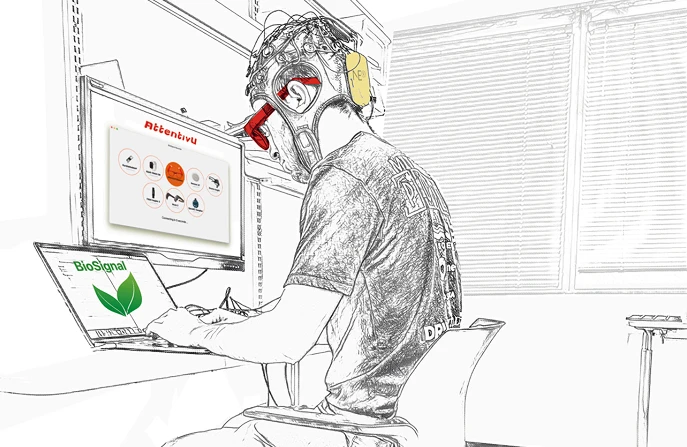
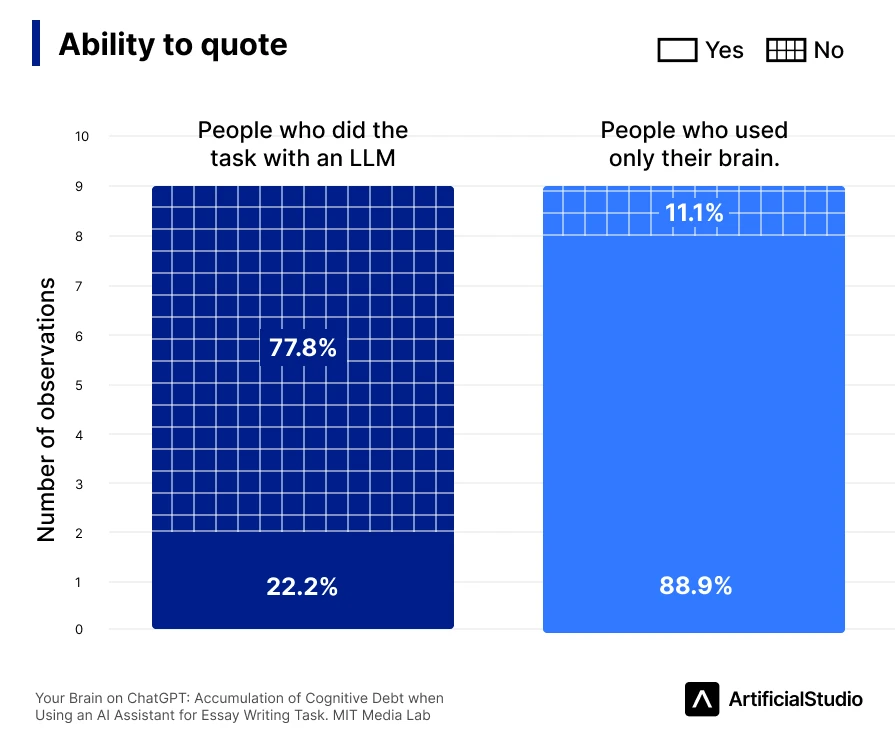
Last year an MIT's Media Lab ran a study titled "Your Brain on ChatGPT," measuring brain activity with EEG while participants wrote essays.
The group that leaned on ChatGPT showed lower neural engagement (many couldn't accurately quote from essays they had "written" just minutes earlier).
The researchers called it "cognitive debt": the work got done, but almost nothing was retained, because the person never really did it.
When you read an AI summary instead of the document, you remember less than if you'd read the document. When AI writes for you, you remember less of what "you" wrote.
Subscribe to get deep dives on tech and the future of creative work.
This matters even for the small stuff
Everyday acts of writing, deciding, and remembering are the reps that keep your mental muscles in shape. If you outsource all of them, the muscle atrophies, so when a genuinely hard, high-stakes problem lands on your desk, you don't have capacity to solve it.
As Sarkar quipped: it's like inventing a cure for exercise, then wondering why you're always out of breath We told ourselves we were solving the problem of having to think.
Don't fix it with less AI, but with a different AI.
You need to use AI differently. The distinction Sarkar draws is:
- Between AI as an assistant: something that does the task for
- And AI as a tool for thought: something that helps you understand the task, ask better questions, and reach a better answer yourself.
Instead of a chatbox you delegate to, imagine AI that surfaces "provocations": counterarguments, alternative framings, and flagged fallacies that push you to strengthen your reasoning rather than replace it.
You still read the important passages yourself and make the judgment calls. The draft that comes out is genuinely yours, because it's rooted in decisions only you made, but you got there faster, and you thought harder along the way.
Three design principles run through it:
- Preserve real engagement with the material
- Offer productive resistance instead of frictionless answers
- Scaffold your ability to think about your own thinking.
How to keep your edge
→ Engage with the raw material at the moments that matter. Read the key source yourself before you ask for a summary of it, don't let AI stand between you and the thing you're supposed to understand.
→ Use AI to widen your options, not to pick for you. Ask it for counterarguments, three different angles, or what you might be missing, then make the call yourself. The goal is more possibilities on the table, not a decision made in your absence.
→ Treat the first output as a provocation, not an answer. If you understand your work deeply enough to confidently reject a suggestion, the process is working. Blind acceptance is the warning sign.
→ Notice your confidence. On the days you're inclined to trust the AI and doubt yourself, that's exactly when the research says your critical thinking slips most. Slow down there.
Creatives of all kinds don't need to stop using AI, just to ask themselves how to use it. Try to make sure AI doesn't erase your memory or ruin your judgment.
Sarkar ends his talk with a great question: What would you rather have, a tool that thinks for you, or a tool that makes you think?
With Artificial Studio you can use AI to create images, video, audio, music, 3D models, and even marketing assets; all based on your decisions and your creative vision. You bring the prompt and the perspective; we handle the execution.
Try it yourself
Start creating with the tools mentioned in this article.