Your brand is what YouTube says it is — Semrush AI Visibility 2026
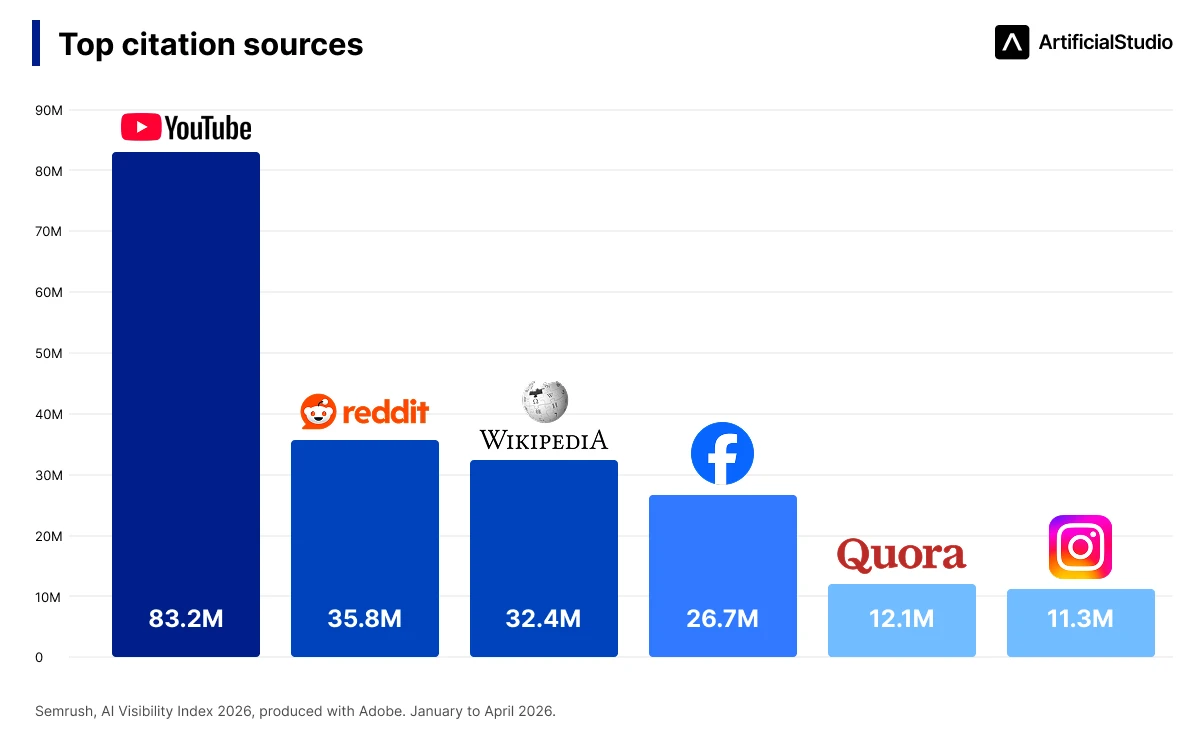
Semrush analyzed, in its 2026 report, 126M AI search prompts. Google's AI Overviews cites YouTube 83.2M times — 2.3x the next source. Video is now a visibility problem.
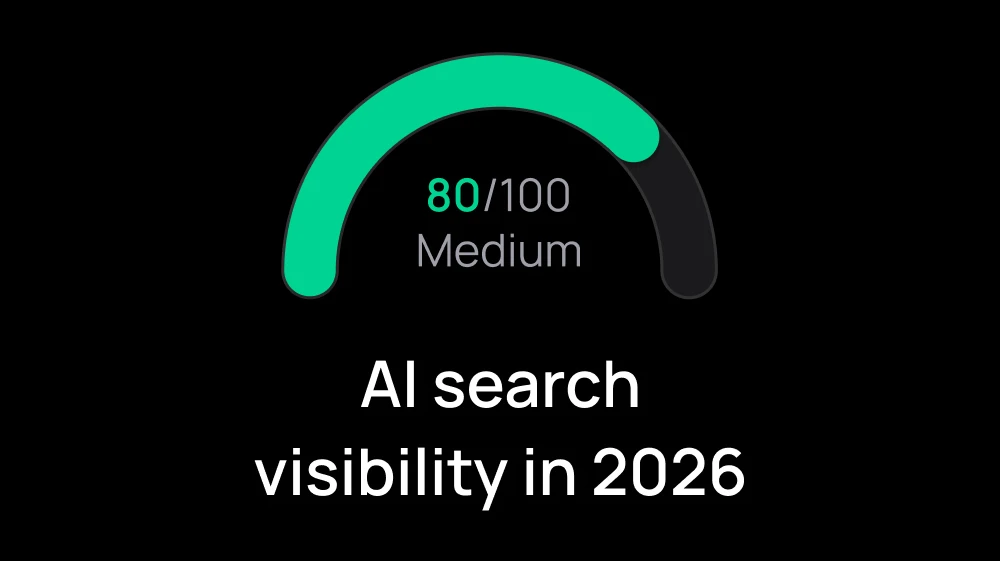
Most coverage of AI search visibility is about text: get your Wikipedia page right, seed the right Reddit threads, publish deeper pages, show up on G2. All of that is real advice and Semrush's 2026 AI Visibility Index supports it.
But between January and April 2026, Google's AI Overviews cited YouTube 83.2 million times. The next most-cited source, Reddit, sat at 35.8 million, and Wikipedia at 32.4 million.
AI Overviews is not a niche surface. Per the report it has roughly 2.5 billion users, more than any other AI answer surface, because there's no opt-in: it sits above Google's organic results whether you asked for it or not.
A brand with no YouTube presence starts at a structural disadvantage that doesn't exist on the other three platforms.
It isn't only YouTube
Google AI Mode (the conversational surface inside Google Search) tells the same story. Its top cited sources are:
- YouTube (25.9M)
- Facebook (22.8M)
- Reddit (17.7M)
- Wikipedia (12.5M)
- Google (11.8M).
Two of the top two are visual platforms. Semrush describes AI Mode's character as social-weighted: it treats social platforms as authoritative for current and conversational content.
In that chart the pattern is hard to miss. YouTube is the number one cited source on two of four platforms and appears in the top four on all of them. Facebook and Instagram carry serious citation weight on the two Google surfaces. On ChatGPT, the encyclopedic one, Wikipedia and Reddit lead and YouTube still lands fourth.
Of the 36 brands Semrush found in the top 100 of every platform in every month of the window, YouTube ranks first with 47.9 million mentions. Only three brands appear in every platform's top 10: YouTube, Amazon, Facebook.
And the report notes something about that group of 36 that's easy to skip past: it contains no traditional news outlets or content-focused publishers. Semrush's read is that AI rewards brands offering something to do, not just something to say.
The platforms are not one channel
Citation overlap between any two of the four platforms runs below 50%. The share of mentioned brands that are also cited as sources swings from 64% on AI Overviews down to 30% on Gemini — a 34-point gap between two platforms both owned by Google.
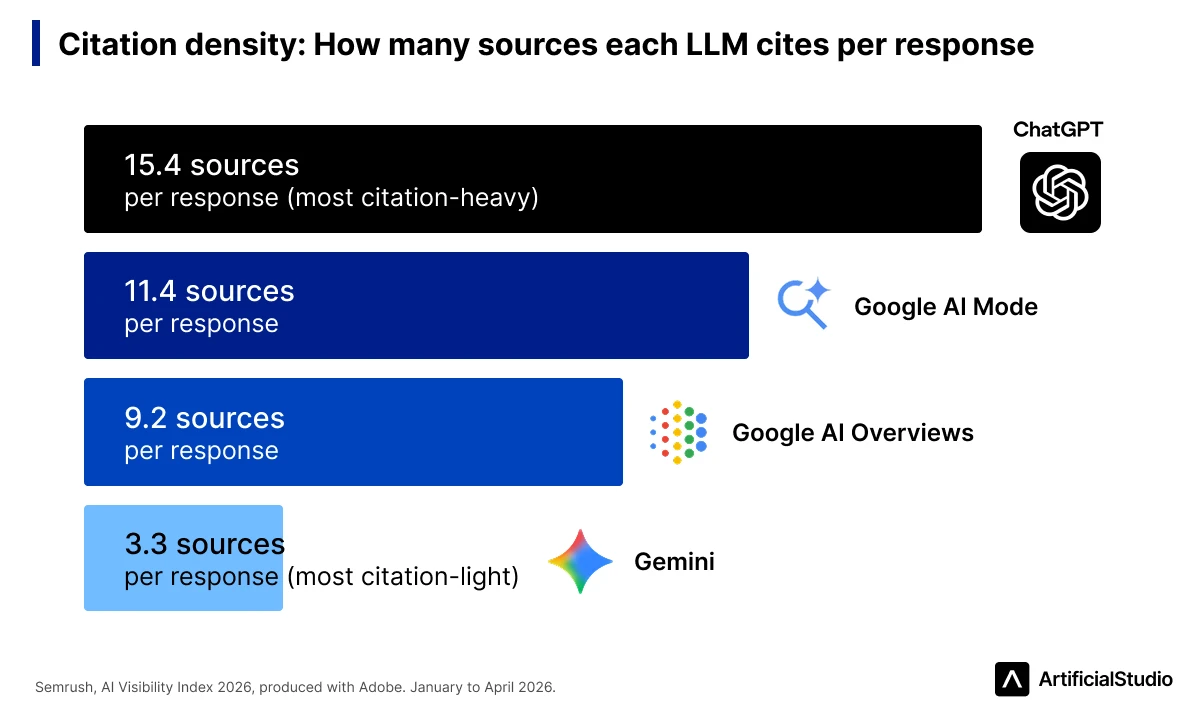
Citation density varies even more sharply. ChatGPT cites 15.4 sources per response. AI Mode, 11.4. AI Overviews, 9.2. Gemini, 3.3. ChatGPT pulls from more than four times as many sources as Gemini for the same query.
There's a structural reason underneath at least part of this. The average AI Overviews prompt is 24.6 characters. On the other three it's around 58. AI Overviews prompts come from Google Search keywords, not conversations — shorter questions, shorter answers, fewer sources pulled.
So the practical version of the video finding isn't "post more videos everywhere." It's that if your audience is finding you through Google's surfaces, video is the citation layer. If they're on ChatGPT, community and reference content carries more of the load.
If you want to know more about where traffic and AI visibility are heading, you can read our article "Everything that scales is now worth less — State of Marketing 2026", which covers this same problem and shows that every format that gained ROI this year is audiovisual.
Subscribe to get deep dives on tech and the future of creative work.
This doesn't mean your brand will improve just by posting videos
Semrush is explicit that adding more content to your own site rarely creates an advantage, because anyone can do it. What AI visibility rewards sits off-domain, in third-party sources — and earning a place there is closer to digital PR than to publishing. Their words: building a Reddit community, or videos that get real engagement on YouTube, takes years.
The most-cited brands own something AI couldn't reconstruct from other sources: IMDb's film database, Investopedia's dictionary, Cleveland Clinic's medical reference depth.
The Patagonia case study makes the same point from a different direction. Six specialist outdoor-gear review sites account for more than 65,000 brand mentions — more than the entire Tier 1 traditional media combined. Patagonia's AI Visibility score has held at 79 or 80 every month. That came from years of a coherent brand story told by an ecosystem of people who aren't Patagonia.
So no, you cannot generate your way into AI search visibility. Publishing forty unwatched videos gets you forty unwatched videos.
What it does mean
If your customers use Google's AI surfaces (and with roughly 2.5 billion people on AI Overviews and about a billion on AI Mode, most brands' customers do) then a video presence is now table stakes for being described at all. Not a growth channel you might test next quarter. The floor.
It is a capacity question and not a strategy question. Plenty of teams already know they should be on YouTube, they publish once a month because that's what one editor and a shared camera produce.
That gap is where tools help, and it's worth being precise about where they don't. Generating a video doesn't earn a citation. But if your constraint is that a good idea takes three weeks to become a finished, captioned, on-brand asset, that's a production problem, and production problems are solvable. Turning scripts and stills into finished video, adding voiceover, and cutting versions per platform are the mechanical parts of the job — the parts that shouldn't be deciding your publishing cadence.
The question organizations keep asking is how do we rank in AI?’ but it misses the point. Most brands are invisible in AI-generated answers entirely, and the ones that do appear often show up wrong: mispositioned, conflated with a competitor, stripped of context. LLMs build a confidence picture from everything the internet says about you, not just your owned content. The organizations getting this right treat AI visibility as a content operations discipline. The ones that don’t will simply stop showing up altogether.
Jordan Jewell, Sr Research Director, Persuasive Content & Digital Experiences, IDC
Four things to do with this
→ Find out which platform actually drives your visibility 🔍 The report shows Cleveland Clinic pulls 86% of its AI mentions from AI Overviews alone, and Yelp gets nearly half of its total from AI Mode. Concentration above 70% on one platform means one algorithm change can take most of your visibility with it. Home Depot, spread within 3.4% across all four, is the opposite case.
→ Check your category before you set a target. 📊 Concentration of top-10 mentions among the top three brands ranges from 82.9% in News & Media to 41.4% in Finance. Above 70%, positions four to ten are the realistic ambition. Below 50%, focused work can move you several ranks in a couple of quarters.
→ Audit how your brand reads on the three sites AI quotes most in your vertical 📝. Semrush calls this your Citation Core, for example:
- G2, Capterra, TrustRadius and Forbes Advisor for US software
- NerdWallet, Investopedia and Bankrate for finance
- Allure and Byrdie for beauty
- TripAdvisor for travel.
→ Treat video as infrastructure, not campaign. 🎥 If YouTube is the most-cited source on the surfaces with the most users, a channel that publishes sporadically is a structural gap. Decide the cadence you need first, then work out whether your current production setup can hit it. Consistency across those assets matters more than polish on any one of them.
Try it yourself
Start creating with the tools mentioned in this article.