How not to burn out on AI: guide for creative teams
AI was supposed to make creative work lighter. Instead, teams are exhausted. Here's why AI fatigue is real. Information from The Clearing's 2026 AI Fatigue report
AI was supposed to give us time back. Fewer hours on the boring parts, more room for the work that actually matters. So why does everyone feel more tired, not less? 💆♂️
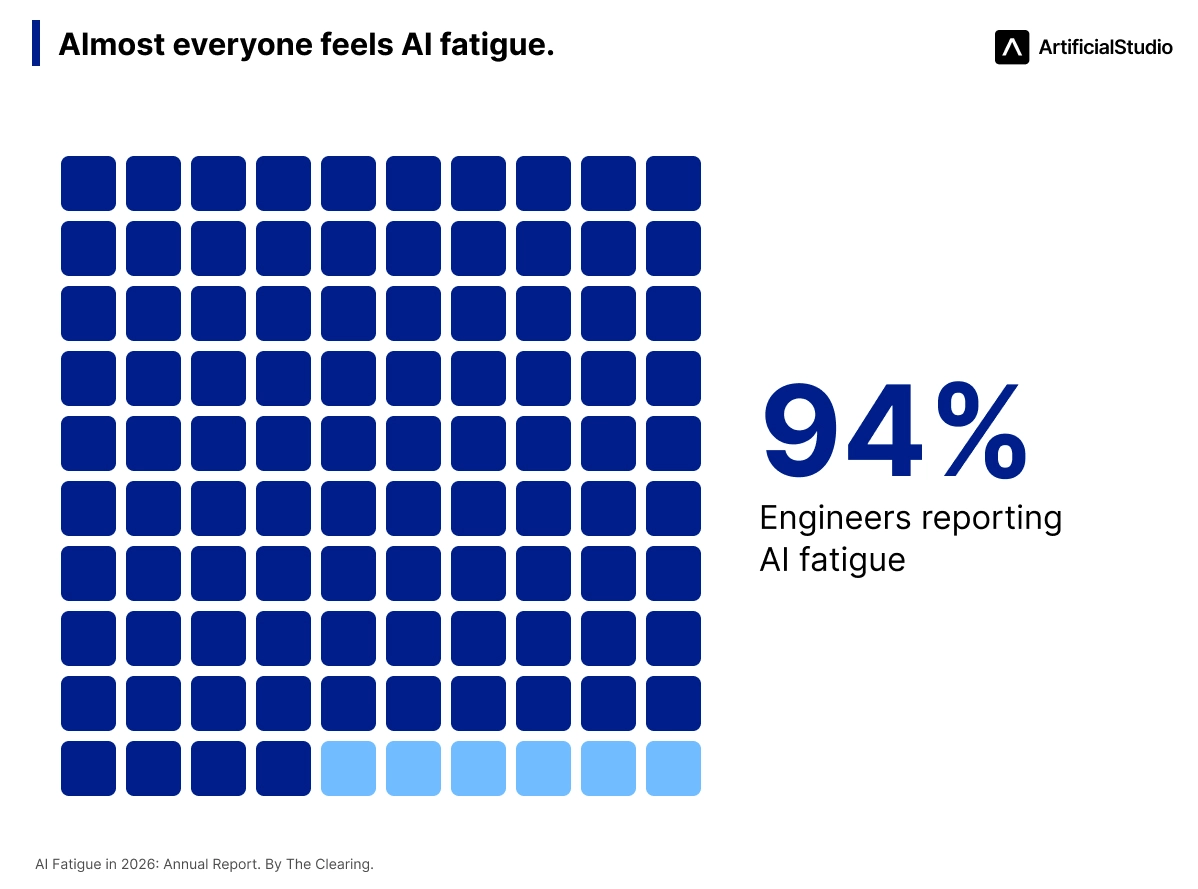
According to The Clearing's 2026 AI Fatigue report (a survey of more than 2,000 engineers):
- 62% said they feel worn down by the constant churn of adopting new tools
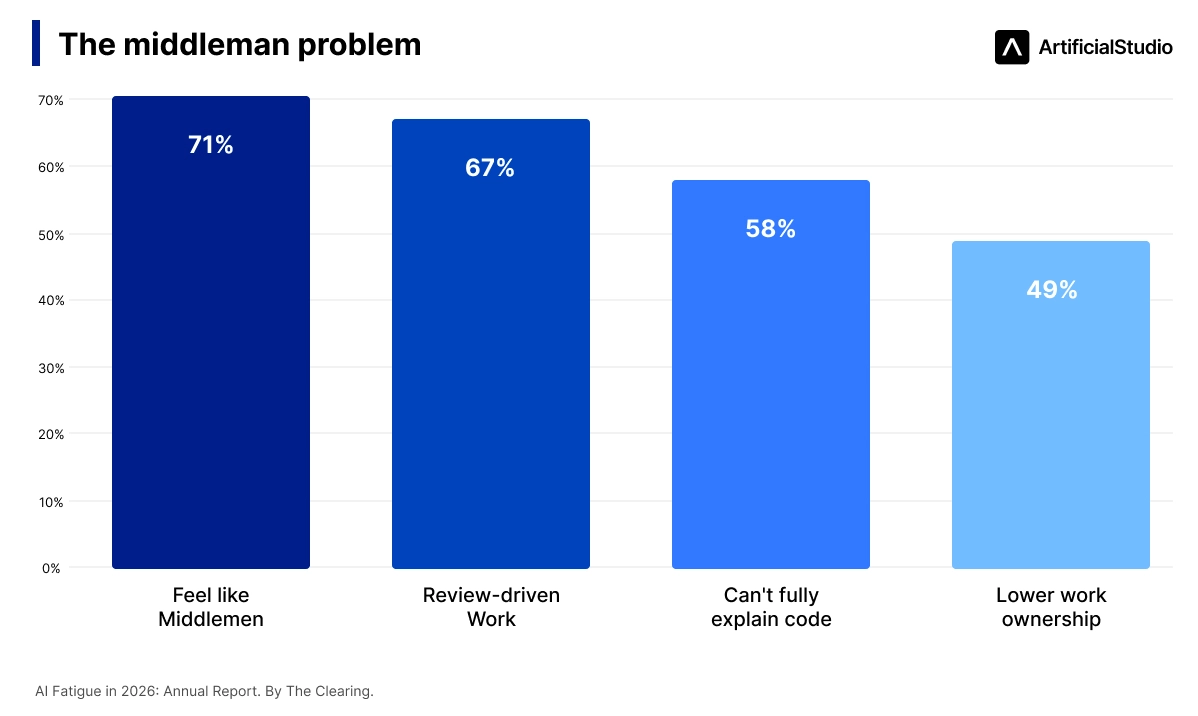
- 58% reported active burnout symptoms
- 71% said they feel less like creators and more like middlemen reviewing and babysitting machine output.
Nearly half had seriously considered leaving their role specifically because of how AI reshaped their day.
When a resource becomes cheaper and easier to use, we don't use less of it, we use dramatically more.
Economists have a name for this: the Jevons paradox. When steam engines became more efficient in 19th-century Britain, the country burned more coal, not less, because efficiency made coal worth using everywhere.
AI is doing the same thing to creative and technical work. The moment generating an image, a video, or a block of code became nearly free, we started generating vastly more of it (and reviewing, fixing, and managing all of it).
That explains the exhaustion. Making the thing was never the real bottleneck. Understanding it, checking it, and shepherding it to "good enough" is.
Research on AI-assisted development has found that:
Developers can end up spending more time reviewing and correcting AI output than they save by not writing it from scratch.
In some studies, review overhead cancels out the speed gains entirely. The tool got faster but the human got busier.
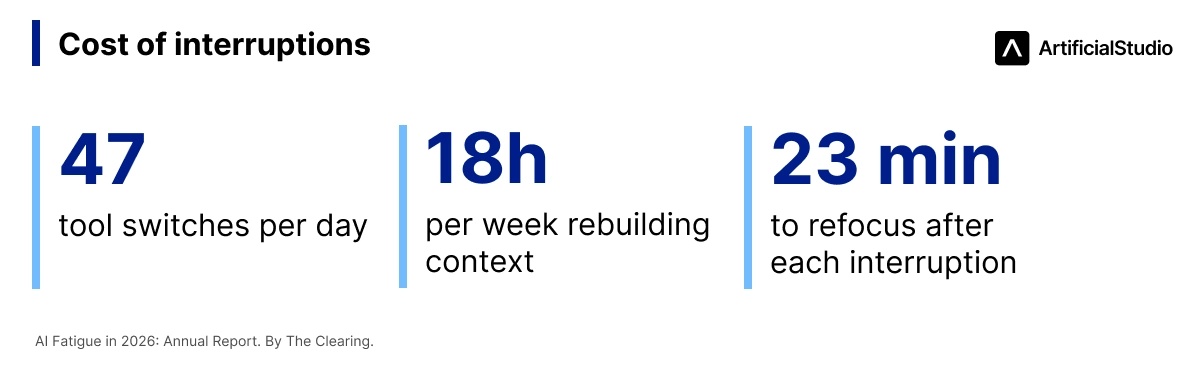
Layer on top of that the context-switching tax. Jumping between a generator, an editor, a chat assistant, a review step, and an export tool means you're never in flow for long. Every switch forces your brain to rebuild what it was doing. That reconstruction is expensive, quietly eating hours out of every week.
The creative trance, keeps getting interrupted by the very tools that promised to protect it.
Builders and "non-programmers" are burning out too
You no longer need to be a programmer to ship a website, app or an automation. A designer can describe what they want in plain language and watch it get built. That's genuinely liberating because more people can make more things than at any point in history.
But it also means the burnout that used to belong to engineers has spread to designers, marketers, and founders who now build too. The same loop applies: prompt, review, fix, prompt again. The same anxiety applies:
"Am I using my subscription enough? Is there a better model I should be on? What am I missing while I sleep?"
When the barrier to building drops to zero, the pressure to always be building rises to match.
The creative version of AI fatigue
For creative and marketing teams, the exhaustion usually doesn't come from one tool, but from the stack.
You're on Runway for video. Midjourney for images. Freepik for assets. ElevenLabs for voice. Maybe a separate tool for upscaling, another for background removal, other for mockups. Five logins. Five interfaces to relearn every time they update. Five credit systems, each with its own math.
Every project becomes a mix of very different browser tabs, with a context switch at every handoff.
Subscribe to get deep dives on tech and the future of creative work.
It's a second job managing your workflow. And it's the exact fragmentation that leaves creative people, the ones who most need long, uninterrupted focus, feeling scattered and drained.
Gloria Mark's attention research at UC Irvine has produced some of the most-cited findings in workplace productivity science. Her work on digital interruptions reveals uncomfortable truths about the cognitive cost of fragmented attention.
- 23 min, the average time to fully resume deep focus after a single interruption
- 64% of interrupted work is resumed the same day — but at a measurably shallower depth
- ~6 sec, the average attention gap before distraction in modern knowledge worker environments
AI coding tools introduce a specific type of interruption: the persistent, low-level cognitive demand of suggestion evaluation. Unlike a Slack notification that clearly arrives and departs, AI suggestions are a continuous presence
"The cost of interrupted work is not simply the time taken to handle the interruption, but the full cognitive cost of interrupted focus and the additional errors that arise from divided attention."
How to not burn out (actually)
The good news from The Clearing's data: Engineers who set structured boundaries reported meaningfully lower fatigue. The fix is using AI deliberately. A few things that help:
1. Protect your flow, not your token count.
The anxiety of "maxing out" your subscription (leaving jobs running overnight, always squeezing one more generation) is a treadmill with no finish line. Decide when you're done for the day and actually stop.
2. Cut the switching, but not the ambition.
Most of the fatigue is transition cost, not effort. Anything that lets you stay in one place (one interface, credit system or mental model) buys back focus you didn't know you were losing.
3. Measure output in outcomes and not volume.
It's easy to feel productive because you generated fifty variations. What matters is whether the work moved something for a real person. Ship for the audience, not for the dashboard.
4. Consolidate your stack.
Every tool you remove is one less context switch. Fewer moving parts is not a compromise. For your attention, it's the whole point.
One place instead of five
Instead of stitching together Runway, Midjourney, Freepik, and ElevenLabs (each with its own tab, bill, and credit system) the calmer setup is a single platform where image, video, audio, and 3D live under one roof, one login, and one pool of credits.
You start from a tool when you know what you want, or just describe it in a chat when you don't, and you stop rebuilding your context every time you change mediums.
That's the idea behind Artificial Studio: 60+ AI tools in one place, so your creative stack stops being something you have to manage and goes back to being something you use. Not because more AI is the answer to AI fatigue — but because less juggling usually is.
But for now, close the laptop and go outside. That part still matters most :)
Try it yourself
Start creating with the tools mentioned in this article.