The year designers stopped being just designers - AI in Design Report 2026
The AI in Design 2026 report by Designer Fund and Foundation Capital reveals a profession mid-transformation. A job description that no longer means what it used to. Here's what changed.
According to the 2026 AI in Design Report, published by Designer Fund and Foundation Capital, based on 900+ responses and 25+ interviews with leaders at Anthropic, Stripe, DoorDash, Miro, Cursor, and others:
We're in the middle of a restructuring so deep that the job description of "designer" might not mean the same thing in 12 months.
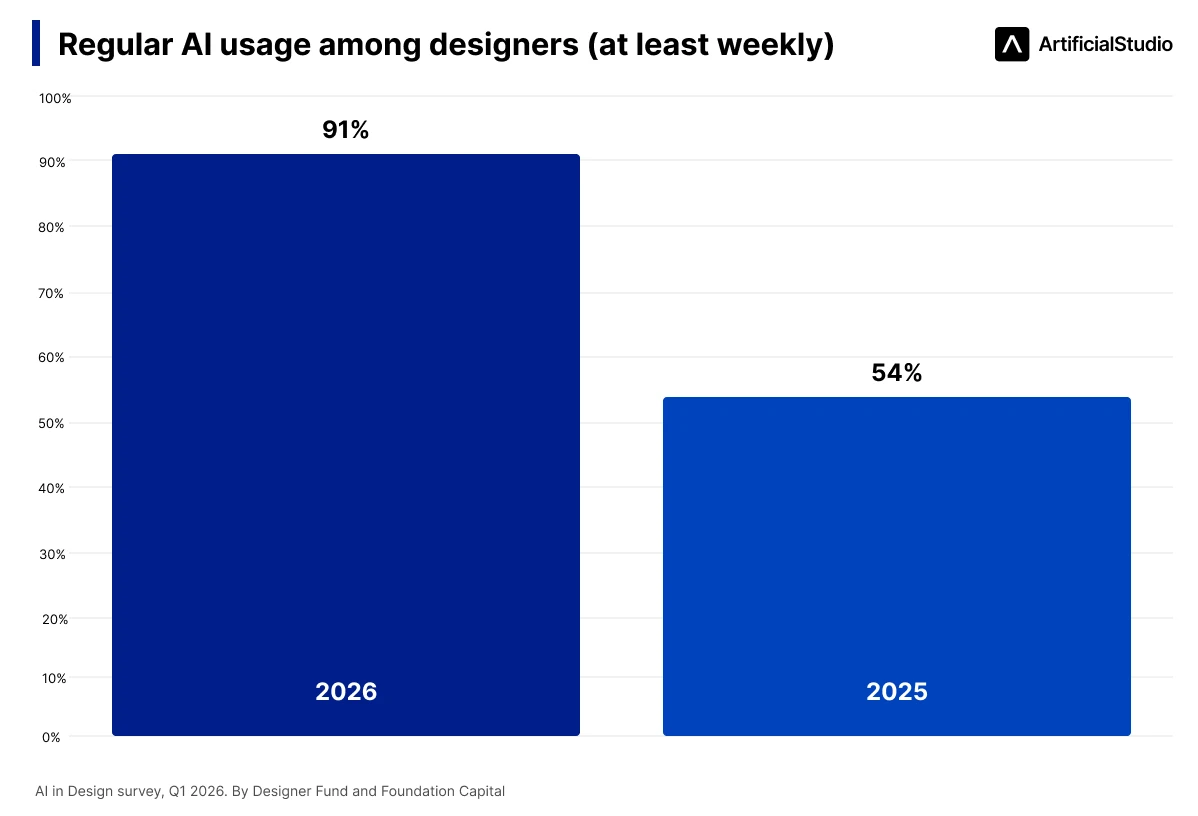
91% of designers now use AI at least weekly, up from 54% in 2025.
That's a 37-point jump in a single year. Three quarters use it daily.
But the more interesting number is this one: the average designer's toolstack went from 3 tools to 7. In one year.
And nearly half of all respondents say they're still searching for their go-to setup.
That's the tension running through the whole report. Adoption has exploded, but confidence hasn't kept pace.
Designers are using twice as many tools and feeling only slightly more certain about which ones actually matter. One respondent described it as a "never-ending molting process." That's a good image. Every few months, you have to shed your workflow and grow a new one.
Claude first, then Figma.
In 2025, ChatGPT was the dominant general-purpose AI tool among designers at 88%. In 2026, it dropped to 65%. Claude jumped from 52% to 78%, now the most widely used AI among this group.
65% of respondents use Claude Code — a tool that didn't even exist when last year's survey was conducted.

80% of designers said reliable, high-quality output is what makes a tool stick. And 62% named inconsistent or unreliable output as their single biggest frustration. The tools that held on are the ones that stopped feeling like a coin flip.
Figma is still here: the UX Tools State of Prototyping survey confirms it's still the most-used design tool in 2026. But what it's used for has changed significantly. Phil Vander Broek from Superhuman put it plainly:
"Figma has shifted from being the primary design tool to a canvas for quick exploration and polishing details as input for Claude Code."
Half of all designers have shipped code.
This is probably the most significant single data point in the report.
50% of respondents (including brand designers, not just product or engineering-adjacent roles) have pushed AI-generated code to production. Only 20% of those respondents identify as design engineers.
The rest are people who, until recently, might never have touched a codebase.
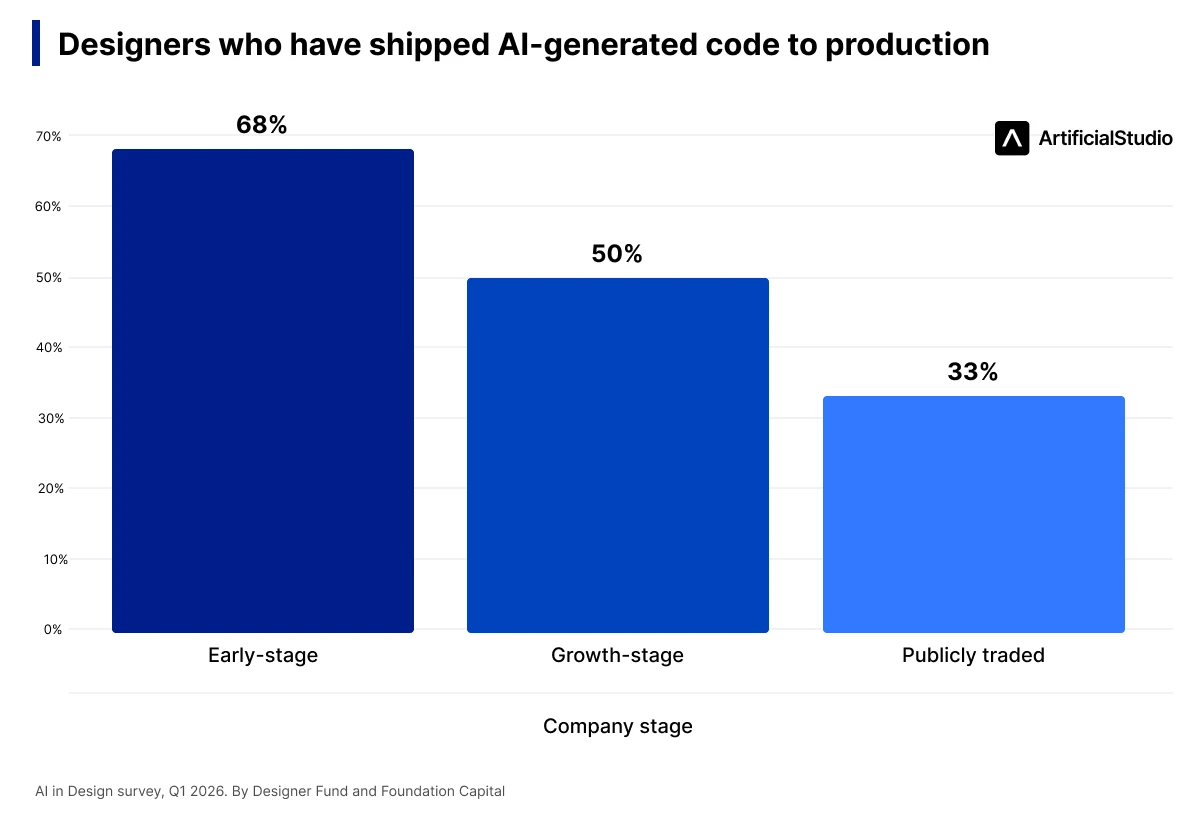
The effect is most pronounced at early-stage companies (68% are shipping code) versus publicly traded ones (33%), which makes sense — smaller teams, fewer gatekeepers, more urgency.
One designer said:
"I fix user issues while we're discussing them and ship before the meeting ends."
Engineers are doing more design work (40% of respondents said so), and designers are writing production code.
The question of who owns what is genuinely unsettled: 34% of respondents say collaboration has become messier, with roles less clearly defined than a year ago.
Designers aren't just using tools, they're building them.
At the individual level, designers are creating microtools when off-the-shelf options don't quite fit (automating a repetitive step, building a dark mode simulator, generating composed moodboards with a custom Figma plugin).
Teams at Stripe, Notion, Anthropic, and others have built internal prototype playgrounds. At Anthropic, designer Nate Parrott built an internal tool that generates interactive prototypes using the company's full design system. Educators, salespeople, and PMs started using it. He said:
"It's as if they were a designer all along and they were just blocked on this one technical skill"
That tool eventually became the foundation for Claude Design.
This pattern: an individual builds something that works, it spreads, it becomes infrastructure; is the dominant mode of AI adoption right now.
Subscribe to get deep dives on tech and the future of creative work.
Peer learning more than doubled year-over-year (from 24% to 70%), while reliance on leadership recommendations dropped in half (from 32% to 16%).
The joy/anxiety split
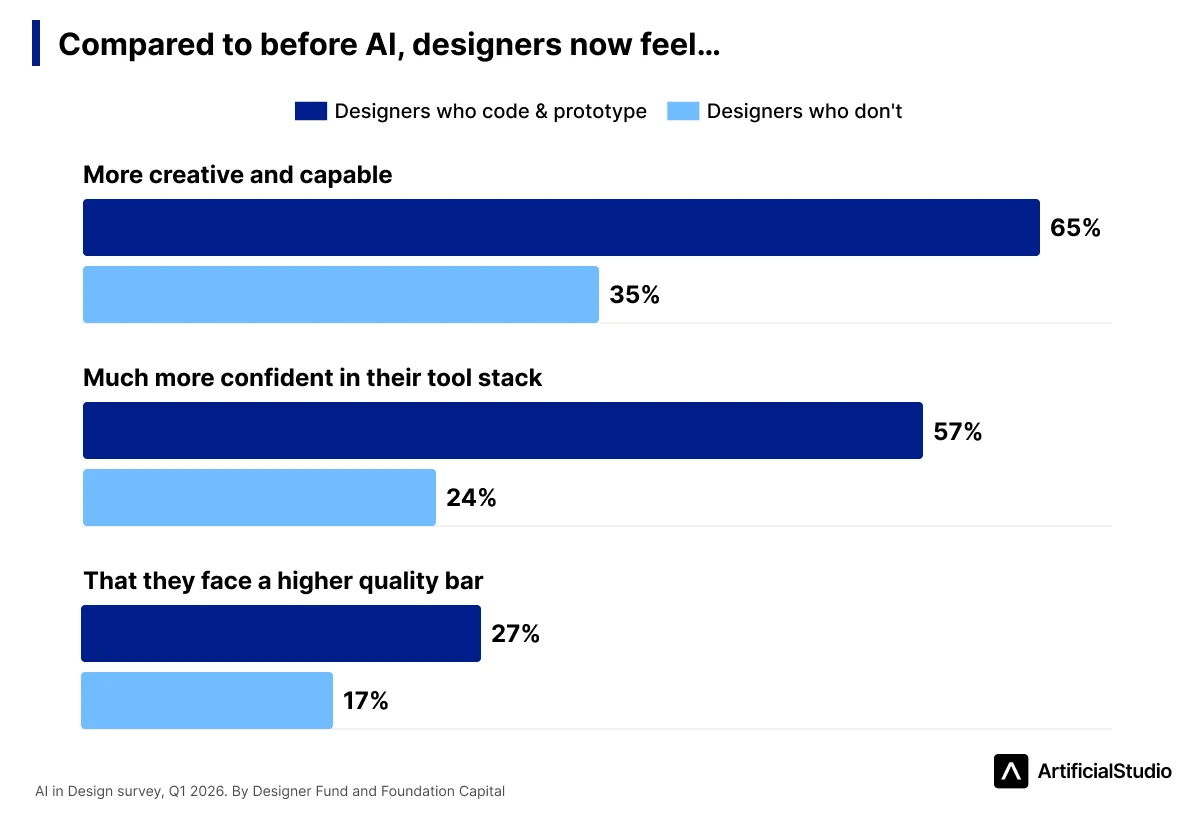
53% of designers report their relationship with their work has improved as a result of AI. They describe feeling more capable, more creative, and less blocked. Designers who build with AI (who ship code and prototypes) are twice as likely to feel more creative and capable compared to those who don't.
But 18% say their job satisfaction has decreased. And some of the quotes in this section of the report are worth sitting with:
"There's loneliness replacing the collaborative energy. Waiting for AI to process replaces flow state. We can do cool things now, but with everyone building independently in a terminal, it's devoid of the interaction that we often need to feel fulfilled."
David Stinnette, Director of Product Design, Samsara
"AI is great, but the expectation of immense speed or 100x productivity has annihilated the joy and pride of the job."
Individual contributor, early-stage startup
Figma built its entire identity around multiplayer design. But Cursor, Lovable, Claude Code: these are solo instruments. The same tools that are making individual designers more capable are also making teams more isolated.
What companies are looking for now
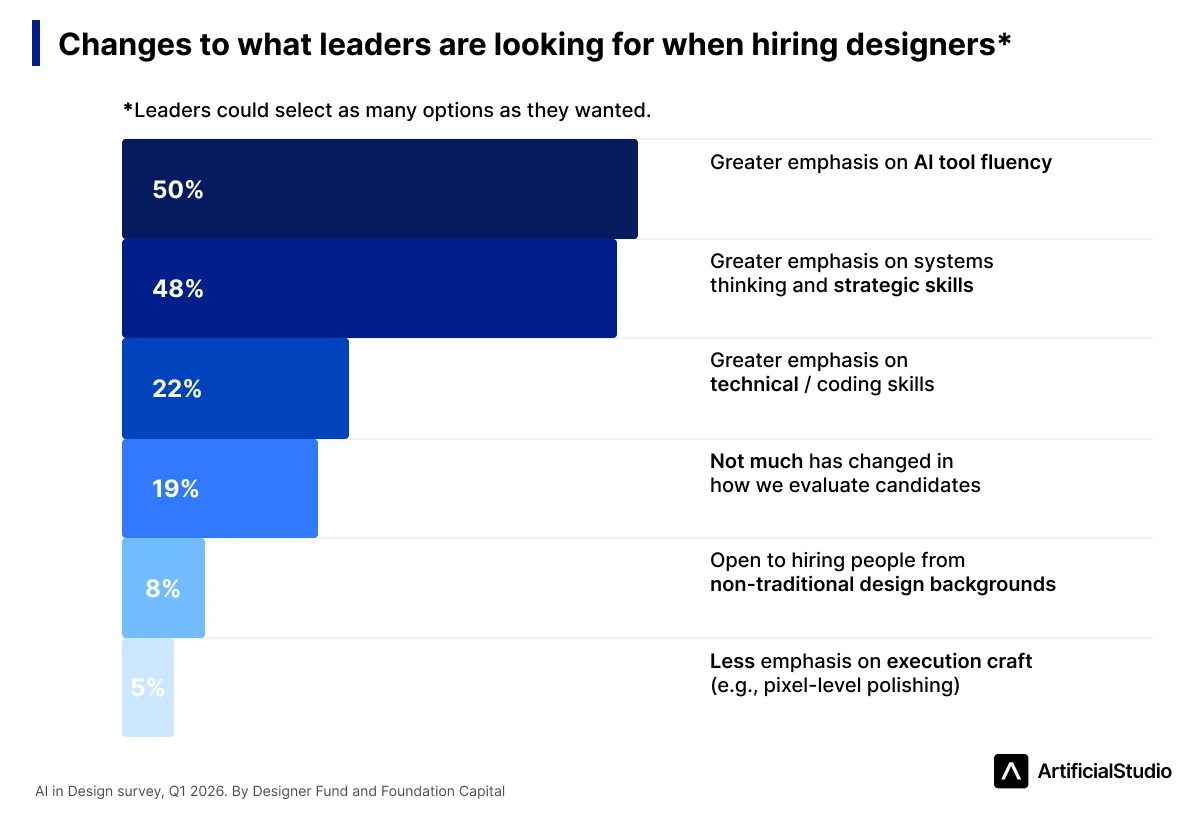
60% of design leaders expect to maintain or grow headcount. That's a healthier number than the narrative around AI job displacement might suggest. But the kind of designer they want is shifting.
The top hiring criteria, in order: AI fluency, systems thinking, strategic skills, and storytelling.
Technical and coding skills came in at 22%. And only 5% of leaders said they're placing less emphasis on execution craft.
The profile that emerged from interviews: someone who can hold a vision while executing on details, who has genuinely rethought their design process from scratch, and who has strong opinions about what software will look like in 6, 18, 24 months.
Not someone who knows every tool, someone who can learn them, and knows when not to use them.
One recruiter in the report put it clearly:
"Many companies are missing out on great talent because they think a candidate needs to come in already knowing every new AI tool. These technologies change constantly, you can't expect mastery yet. The better approach is to hire for potential, taste, and motivation."
What this means if you're not a designer
Anonymous individual contributor at a growth-stage company:
"AI collapsed the distance between idea and execution. I can now own and drive projects end-to-end at a scale that would've required a full team before. The experimentation ceiling basically disappeared."
The ability to go from concept to prototype to shipped product with one person, or two, or a small studio, used to require significant capital and headcount. That requirement is changing faster than most industries have processed.
For solo creators and small teams navigating this, the toolstack question is real. Seven tools on average is a lot to evaluate, pay for, and keep up with. The designers who feel most confident aren't necessarily using the most tools. They're the ones who found the right fit and built their workflow around it.
Things nobody has figured out yet
Nobody knows what the "standard" design toolset looks like now. Nobody knows whether the quality ceiling will keep rising or not.
Nobody knows what the role of a junior designer becomes when so much execution can be automated — and whether craft atrophy is a real risk or a moral panic.
What's clear: the designers who are thriving right now are the ones who treat their workflow as something they build, not something they're handed. They're not waiting for the right tool to arrive. They're building it.
Based on the AI in Design 2026 Report by Designer Fund and Foundation Capital. Survey: 906 respondents across 60+ countries, Q1 2026. Interviews: 25+ design leaders at Anthropic, Stripe, DoorDash, Notion, Linear, Framer, Miro, Cursor, Samsara, and others.
Try it yourself
Start creating with the tools mentioned in this article.