Companies aren't cutting creatives. They're eliminating the managers.
Cisco, Coinbase and GitLab are laying off thousands of managers — while posting record revenue. Here's what this structural shift actually means for creative professionals, freelancers, and anyone who makes things for a living.

Cisco announces 4,000 layoffs. At the same time, it reported 12% annual growth and record revenue. When the CFO was asked about the contradiction, the answer wasn't about saving money. It was about "optimizing the structure."
Coinbase cut 14% of its staff. GitLab eliminated three layers of management and announced 30% headcount reductions while simultaneously creating 60 new flat R&D teams. Meta quietly laid off 21,000 people, and watched its stock price recover massively as a result.
None of these companies are struggling. All of them are making more money than ever. So what's actually happening?`
This isn't about cost-cutting. It's about layers.
Fewer management layers, more direct reports per leader, and a strong preference for people who actually make things over people who coordinate the people who make things.
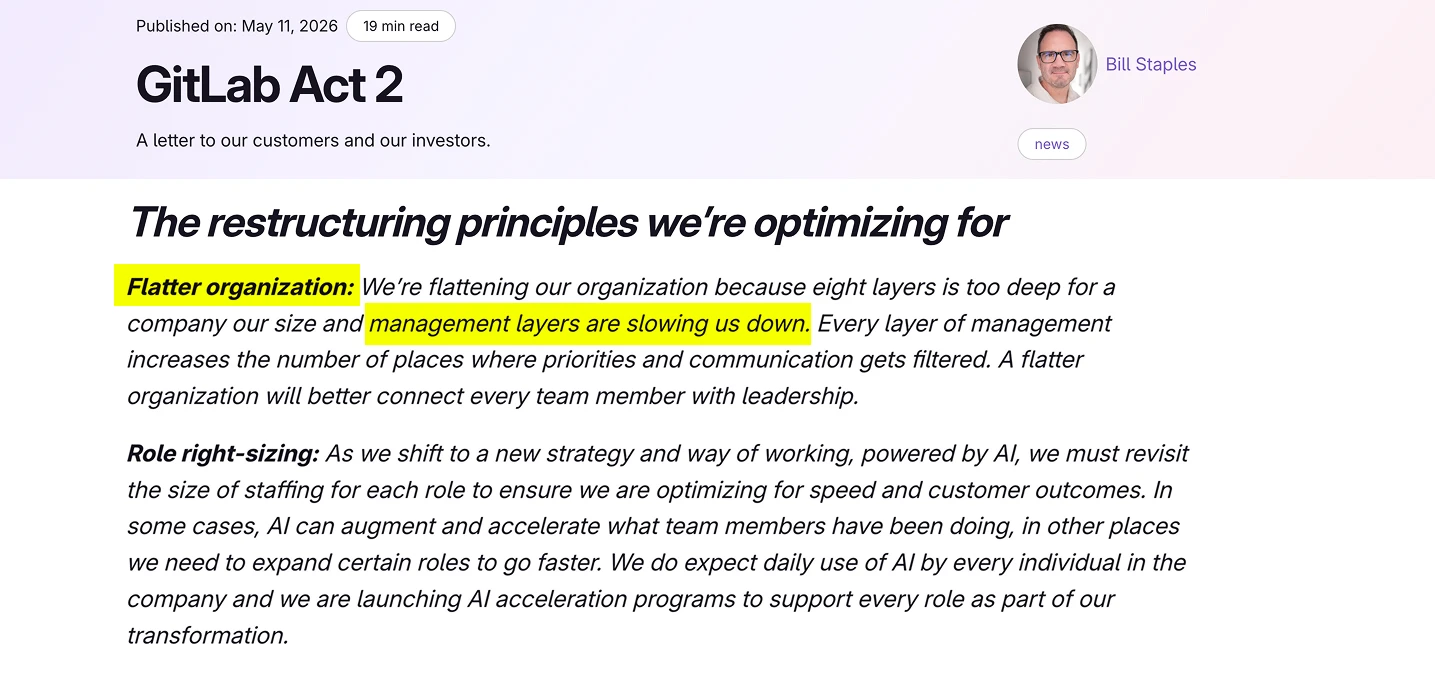
💡 Coinbase made it explicit. Their new target: a maximum of five organizational layers between the CEO and the individual contributor, with each manager overseeing at least 15 direct reports.
GitLab had eight layers and decided that was too many. Bayer went from 12 management layers to 6, eliminating 12,000 positions in the process, and the company grew!
👉 In the 1990s, the average manager oversaw 5 people. By 2010, the accepted standard was 7. By 2023, it was 8. The target for most companies by 2026 is 15.
Why now? Because AI absorbed the job that justified the middle layer.
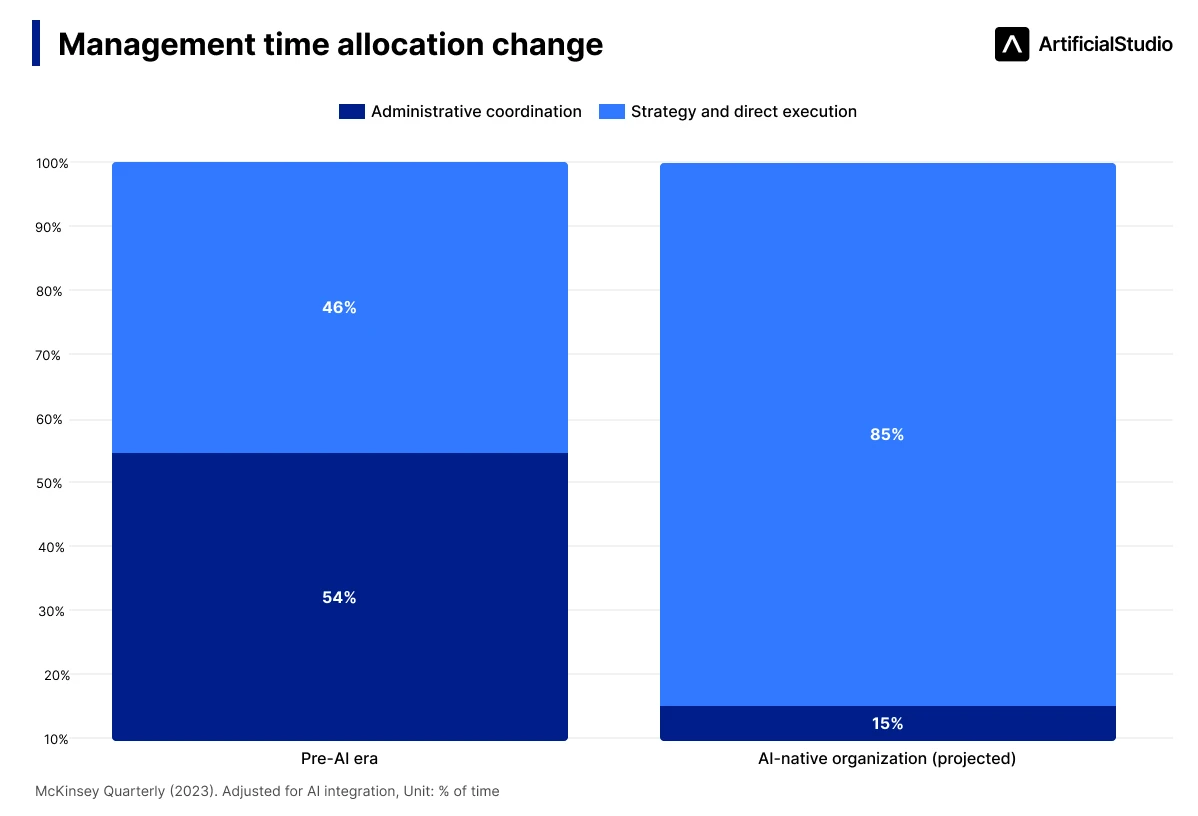
Research consistently shows that managers spend roughly 23% of their time on administrative work: moving data around, filling in reports, chasing approvals, scheduling.
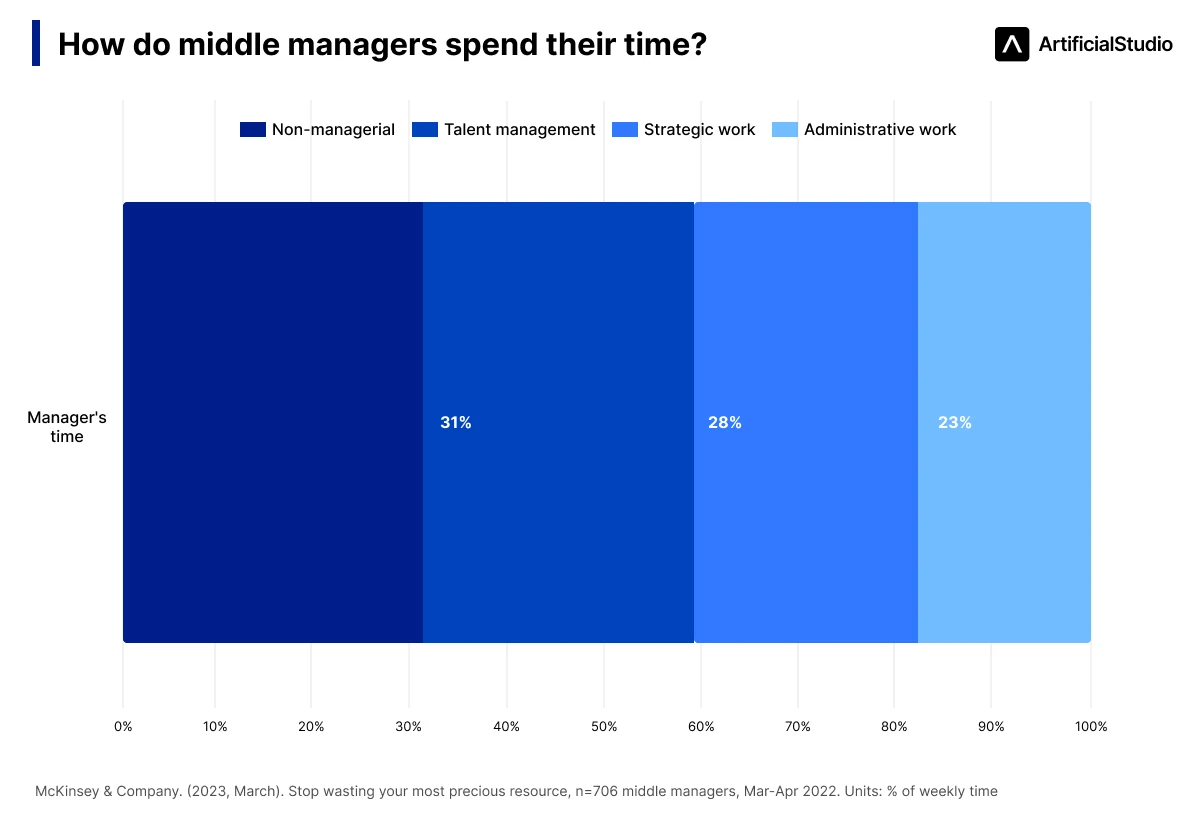
Another 18% or so goes to individual contributor tasks that arguably shouldn't be theirs at all. That's nearly half the role doing things that AI can now handle faster and with less friction.
🧮 The other reason is mathematical. There's a formula, known since the 1970s, that describes how communication complexity grows with team size.Three people have 3 communication nodes between them. Six people have 15. Thirty people have 435. A team of 150 has over 11,000.
Every time you add a person, you don't add one communication line — you add many. Management layers existed, in part, to contain that complexity.
AI is now doing a meaningful portion of that containment work. Summarizing, coordinating, routing, synthesizing. Which means the human layer that existed to manage information flow between other humans is harder to justify.
Who's actually at risk — and who isn't
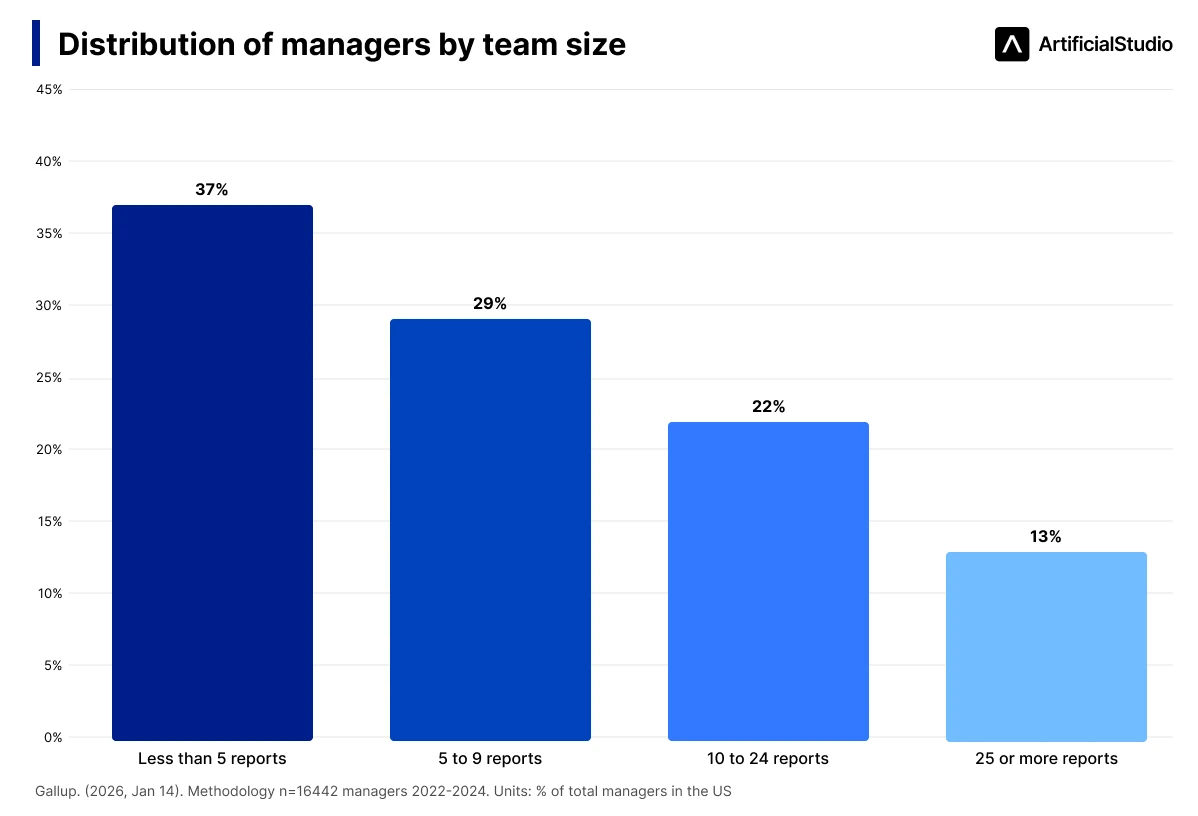
The layoffs are concentrated in a specific profile: managers leading five or fewer direct reports.
According to Gallup data, 37% of all managers fall into this category. These are the coordinator roles, "lead" titles, people one or two layers down from the executive team who exist primarily to pass information up and instructions down.
Subscribe to get deep dives on tech and the future of creative work.
What's not disappearing is the work itself. The World Economic Forum projects that while 92 million jobs will be displaced by AI-related structural changes, 170 million new ones will be created — a net gain of 78 million positions.
And the jobs being created overwhelmingly go to individual contributors: people who build, design, write, develop, and produce. Not the people who schedule the meetings about the people who do those things.
Gallup's workforce surveys show that manager engagement (the percentage of managers who feel genuinely connected to their work and their company's mission) was already at 31% in 2022. It dropped to 27% in 2024, and projections for 2026 put it at around 18%.
If you're a creative professional
If you're a freelance designer, a motion graphics artist, a photographer who also edits, a brand strategist who also executes — this is good news, even if it doesn't feel like it at first.
People worry that AI is coming for the work — the actual making of things. But the evidence points somewhere else entirely (at least in the near future).
💡 The layer being compressed is the coordination layer, not the creation layer. The account managers, the project coordinators, the traffic managers, the people whose job was to be the interface between the client and the person actually doing the work.
What that creates is a direct line between the people who need creative output and the people who can produce it. Fewer intermediaries and approval chains. Less friction between brief and delivery.
For creative agencies, this is a structural opportunity
👉 The agencies that will grow over the next few years aren't necessarily the ones with the most headcount. They're the ones where each person produces more — where one art director with the right tools can deliver what used to require a small team, and where the business model reflects that leverage rather than billing hours against headcount.
👉 For individual creators, the math gets interesting. One person who can generate images, animate content, create variations, adapt formats, and deliver across channels isn't competing with a team anymore. They are a team.
The practical shift
Amazon has had a version of this rule in place for years. Jeff Bezos called it the two-pizza rule:
If a team can't be fed by two pizzas 🍕 it's too big.
In practice that means keeping teams between six and eight people — small enough that communication stays direct, decisions stay fast, and no one exists purely to relay information between other people.
General Electric went from nine management layers to four between 1981 and 2001, reducing headcount from 411,000 to 292,000 while growing its market value from $1 billion to $300 billion. It took them twenty years.
The question for anyone in a creative field is whether you're positioned as the person whose output justifies the investment, or as the layer between two people whose output does.
The answer, consistently, is the same: the individual contributor who uses AI well produces more than the team that doesn't. That's the profile the market is currently paying a premium for, and the profile that survives restructuring intact!
For creative teams looking to increase per-person output without scaling headcount, Artificial Studio gives individuals and small teams access to 60+ AI tools for image, video, audio, and branding. Built specifically so one person can produce across every format a modern brief requires.
Try it yourself
Start creating with the tools mentioned in this article.