The retail AI boom has a talent bottleneck - AI in Retail Report 2026
NVIDIA's 2026 retail AI report shows record ROI and budgets, but the real bottleneck moved to content and talent. Here's what the data actually signals.
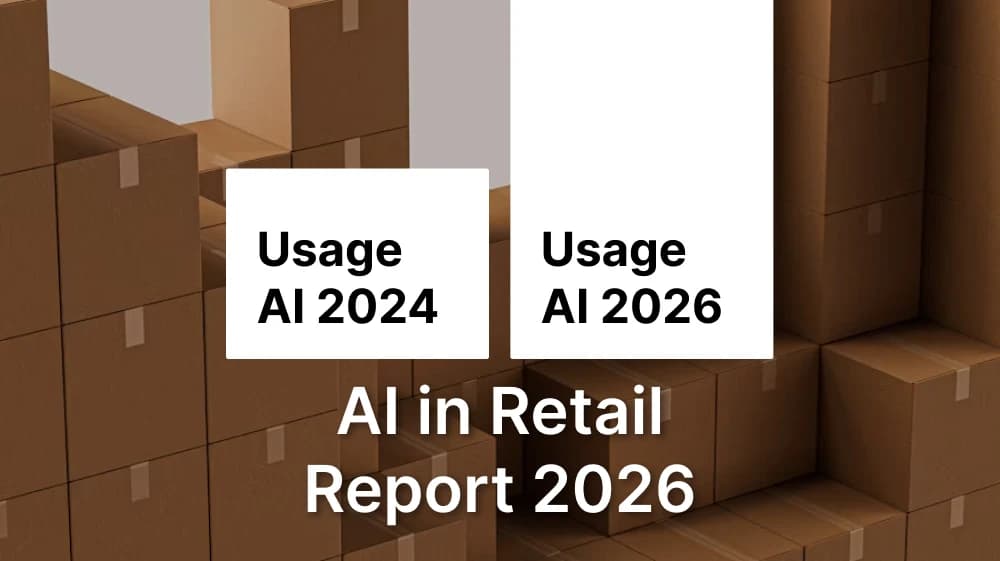
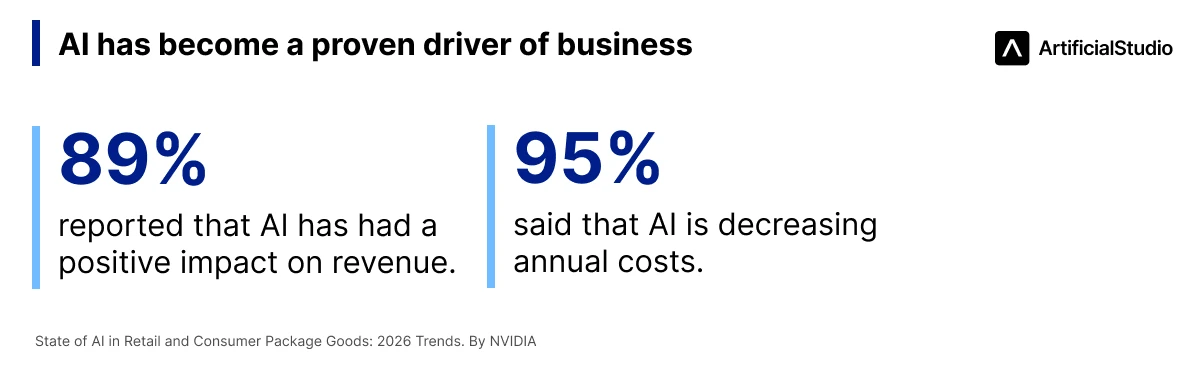
According to NVIDIA's third annual survey of retail and consumer packaged goods professionals, 89% of organizations say AI is now increasing their revenue, and 95% say it's lowering their costs.
92% of executives plan to grow their AI budgets in the next year, and 58% expect to grow them by more than 10%. The industry has clearly stopped asking whether to invest in AI and started arguing about how to deploy it faster.
Two years ago, the thing strangling retail AI was data. Companies spent years cleaning, organizing, and labeling it.
That problem is fading fast: the share of retailers citing training data as a top challenge fell from 27% to just 13% this year.
The new barrier to AI implementation in 2026 is a talent shortage
And it didn't creep up, it leapt, from 31% of respondents last year to 46% this year.
Budgets are climbing and the appetite is at an all-time high, the limiting factor is no longer the machines or the data, it's whether you have enough skilled people to turn all that investment into actual output.
As the report puts it, investment appetite is starting to exceed execution capacity.
For anyone who owns marketing, brand, or e-commerce: digital commerce is the single biggest arena for AI in retail (cited by 61% of respondents and growing).
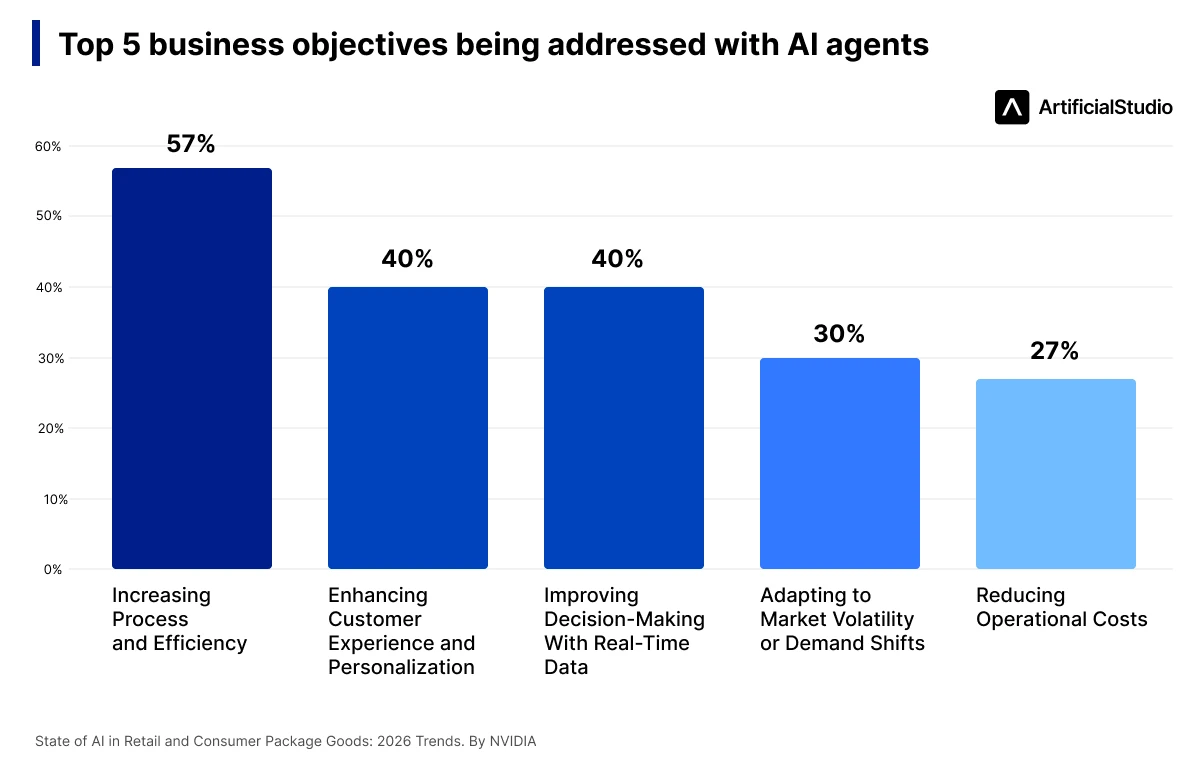
What teams are actually using AI for:
- Marketing and advertising — 67% (the top use case)
- Content creation — 58%
- Advertising placement — 54%
- Adaptive advertising — 52%
- Catalog enrichment — 42%, which the report defines as "enhancing product information: text, images and video."
The list reads like a creative department's job description.
The work growing fastest is production work. More campaigns, creative variants, product imagery and video. Personalized marketing and advertising shows up again as a top agentic use case at 48%.
Demand for produced creative content is exploding. The hardest resource to find is the people who produce it 🧑💻👩💻👨💻
Subscribe to get deep dives on tech and the future of creative work.
Why the smaller players might come out ahead
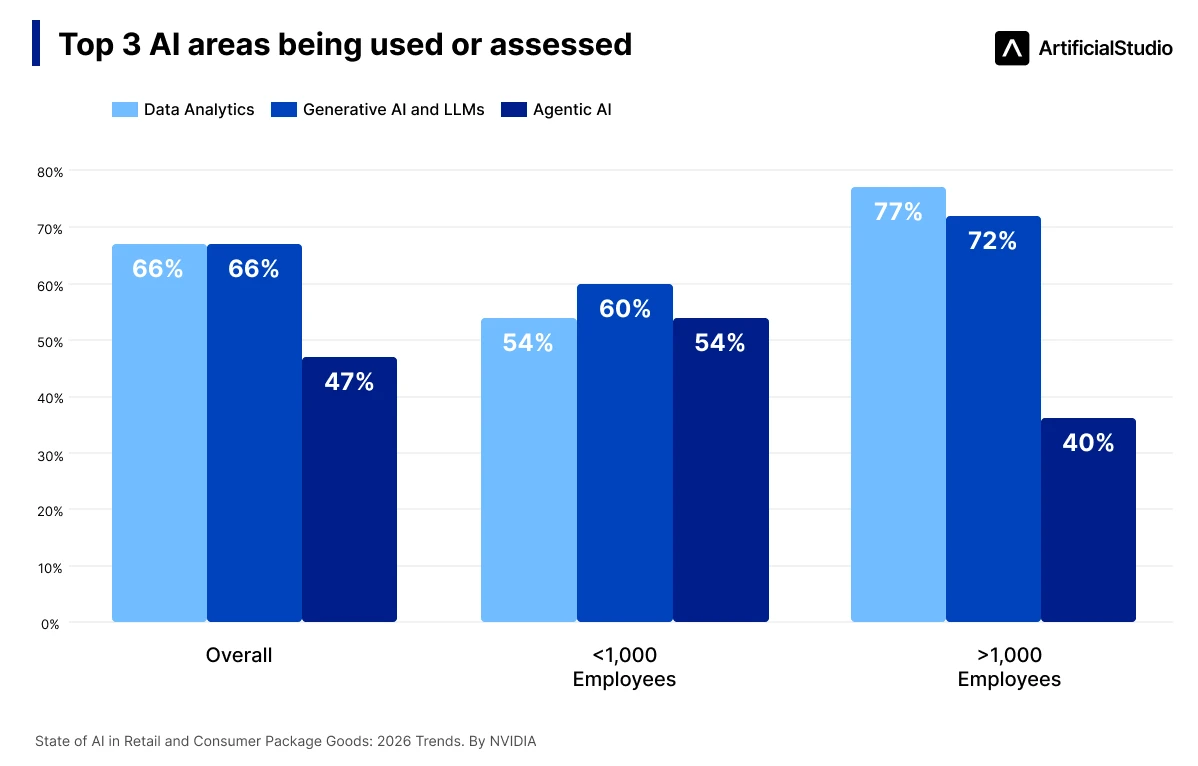
Agentic AI adoption is higher among smaller companies (54%) than larger ones (40%).
Smaller, more resource-constrained teams are leaning on AI to help companies extend capacity and automate with fewer resources.
When you can't out-hire a competitor, you out-leverage them. The teams that win the content race won't necessarily be the ones with the biggest creative departments, they'll be the ones who figured out how to produce studio-quality output without a studio-sized headcount.
👉 Flexibility beats lock-in: 79% say integrating open-source models and tools into their stack is moderately to extremely important, because no single model is best at everything and betting the company on one is a risk.
👉 The cost discipline is real: the top inference concern is cost efficiency and total cost of ownership (41%), because at production scale, "even fractions of a penny per query accumulate into substantial annual expenses."
When you're generating thousands of images, videos, and product variations, the price per asset is the difference between AI as a profit driver and AI as a cost center.
TL;DR
- The fastest-growing demand in retail AI is creative and marketing content — images, video, ads, localized catalogs.
- The scarcest resource is the talent to make it.
- The smart money is on tooling that extends a small team's capacity.
- The winning stack is open and flexible — many models, not one.
- And every asset has to be less expensive than others to produce at scale.
It's the gap Artificial Studio was built to close. Instead of staffing up, or stitching together separate subscription for image generation, video, voiceovers and product photography — a small team gets 60+ AI tools in one place.
Ad creative, video, product images without a photoshoot, packaging, virtual try-on, 3D models and all types of marketin assets. Because it runs dozens of best-in-class models rather than locking you into one, it answers the same "stay open and flexible" instinct 79% of leaders said matters.
NVIDIA's data says retail's content demand is about to outrun its content workforce. The companies that thrive won't be the ones that try to hire their way out of that. They'll be the ones that give a lean team the leverage to produce like a large one — which, conveniently, is exactly what this kind of tooling is for.
Try it yourself
Start creating with the tools mentioned in this article.