Why designers who lean into AI are happier
Figma's State of the Designer 2026 shows AI doesn't replace craft, it amplifies it. Here's what the data means for creative teams that want to win with AI.
There's a fear haunting every creative team right now: that AI will flatten everything into the same glossy and generic sameness. That in a world where anyone can type a prompt and get a passable result, good work stops mattering. The data says the opposite.
Figma's newly released State of the Designer 2026 report — a survey of 906 designers across five regions, conducted with independent research firm NewtonX — paints a different picture.
AI isn't erasing the value of creative work, it's raising the stakes on the one thing machines can't generate on their own: taste.
AI went mainstream, and the results are surprisingly good
According to the report:
- 72% of designers now use generative AI tools
- 98% increased their usage in the past year
AI is the fastest-growing category in the creative toolkit.
What's striking isn't the adoption, it's the sentiment. Among designers who lean in:
- 91% say AI improves the quality of their outputs
- 89% say it helps them work faster
- 80% say it helps them collaborate better.
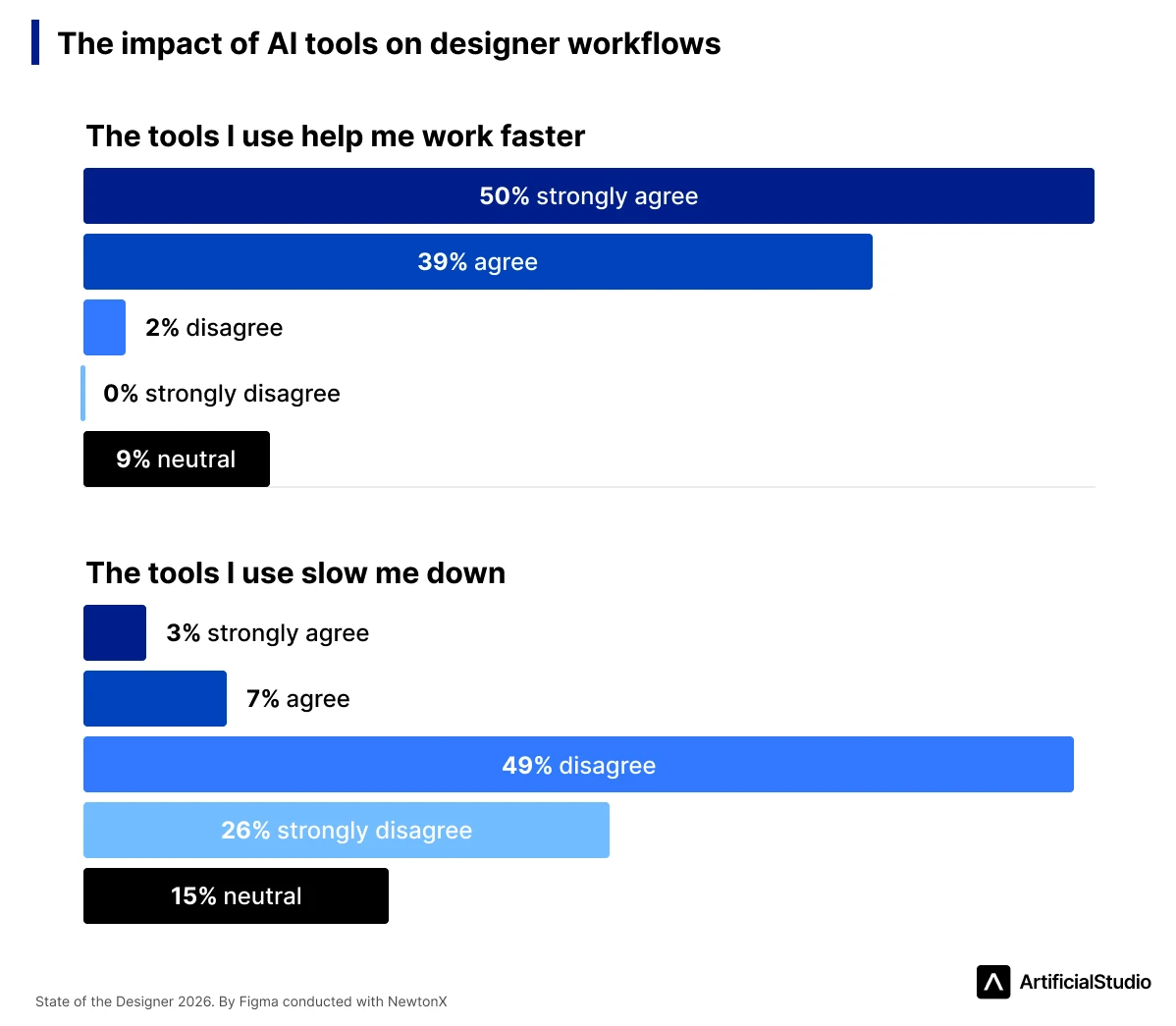
That directly contradicts the "AI slop" anxiety. As Figma puts it:
Despite fears about AI slop and low-quality outputs, in practice, designers are finding the opposite to be true.
The people actually using these tools every day aren't watching their standards collapse. They're watching their range expand.
Designers who are ramping up their AI use are 25% more likely to report increasing happiness than those who aren't. Among designers whose AI usage has stalled, 40% say their job is getting worse — more than double the 18% rate among those leaning in. Even business momentum tracks with it: AI adopters are more likely to say their company is growing faster than the industry average (41% vs. 33%).
Experimenting with these tools tends to turn abstract dread into concrete capability, and that shift shows up in how people feel about their work.
When anyone can generate, craft becomes the moat
In an era where anyone can prompt their way to a prototype, craft — the choices behind user interactions, visual systems, language, and product quality — becomes the differentiator."
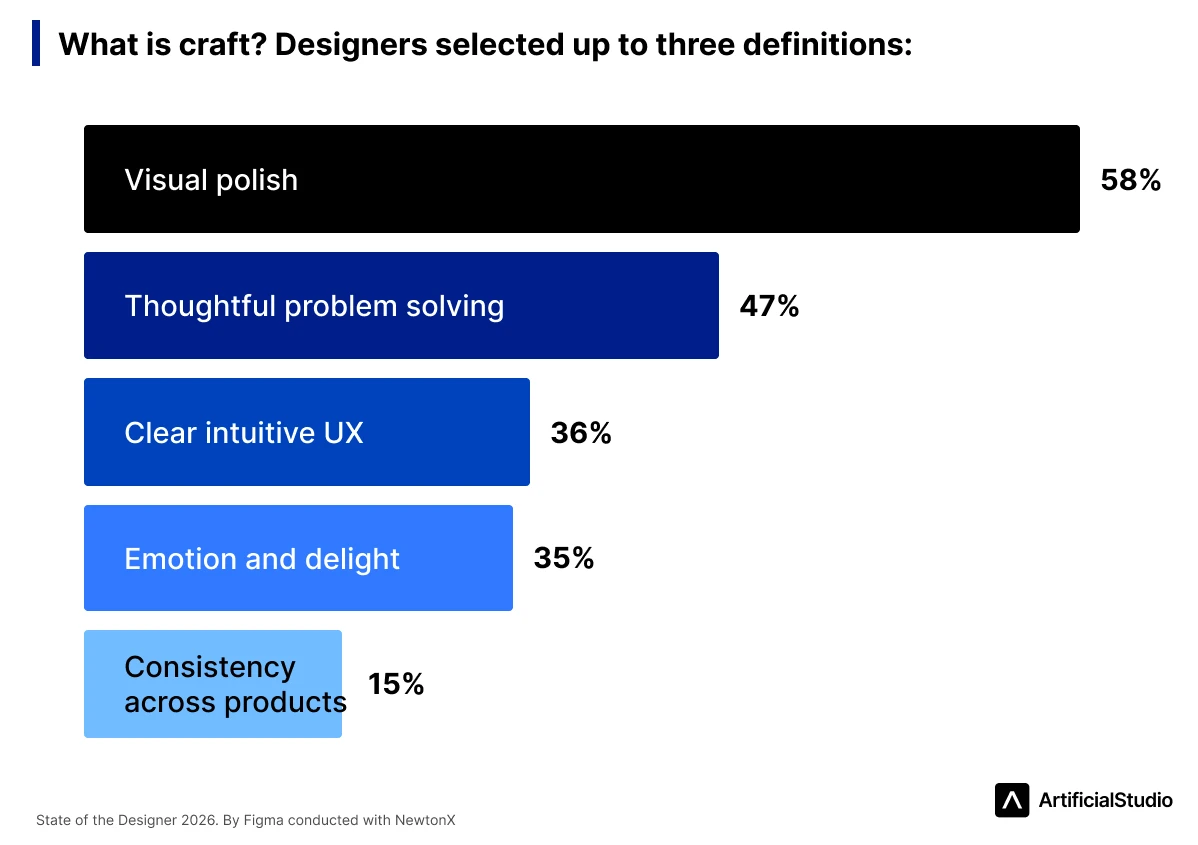
When the cost of producing something drops to nearly zero, the value moves entirely to producing the right thing. Figma found that "visual polish and attention to detail" is how most designers (58%) define craft, and that designers who tie their craft to visual quality and emotional resonance report both higher job satisfaction and better business outcomes.
Taste is now the competitive edge, and not just a soft skill.
A designer in 🇧🇷 Brazil captured the tension precisely:
The increase in the use of AI tools makes things much faster, but at the same time, makes everything seem too perfect and too generic. The precise designer's vision is what makes the difference.
Subscribe to get deep dives on tech and the future of creative work.
Amplify, don't automate
The most reassuring finding in the report is about control. Figma is explicit that the productivity gains from AI "don't appear to come at the expense of craft or autonomy," and that AI and craft not only coexist, but go hand in hand.
AI can accelerate exploration while leaving the core creative decision-making up to designers.
That distinction (accelerating exploration and keeping the decision-making human) is everything.
Creative freedom is the single biggest driver of designer happiness in the report:
- 29% rank it as their number-one factor
- nearly half (48%) place it in their top three.
Meanwhile, 87% say autonomy helps them do their best work.
It's worth noting this pressure isn't limited to people with "designer" in their title. As the report highlights, AI tools are "democratizing design", inviting product managers, developers, and other non-designers into the creative process. The barrier to making has collapsed, which only makes the barrier to making something good more valuable.
Whether you're a designer, a marketer, a founder or a freelancer wearing all three hats, the same rule applies: the output is only as strong as the judgment behind it.
What this means for creative teams
The winners won't be the teams that generate the most, they'll be the teams that direct the best. AI is the fastest way to explore: craft, taste, and a clear creative vision are what turn exploration into work you're proud to ship.
That means choosing tools let you move fast across mediums like image, video, motion, 3D, all without handing over the creative decisions and fragmenting your process across a dozen disconnected apps and logins. The goal is range without losing your point of view.
That's the idea behind Artificial Studio: a single creative platform with 60+ AI tools, where you can upload your own references, lock in your own visual style, and generate across formats, while every creative call stays yours. It's built for exactly the workflow the Figma data points to: use AI to widen what's possible, and let your craft decide what's worth keeping.
The future the report describes isn't one where AI replaces designers. It's one where, in its own words, the people who thrive "will be those who harness AI to amplify their thinking while protecting the craft, judgment, and collaboration that define exceptional work".
The tools got faster and your taste just got more valuable.
Try it yourself
Start creating with the tools mentioned in this article.