Why 80% of companies see no ROI from AI
AI adoption is at record highs but most companies see no measurable return. Here's what the 5% that actually gets value from AI is doing differently, and how creative teams can copy it.
Nearly 9 in 10 organizations now report using AI in some form. Global investment is on pace to cross half a trillion dollars this year.
And yet:
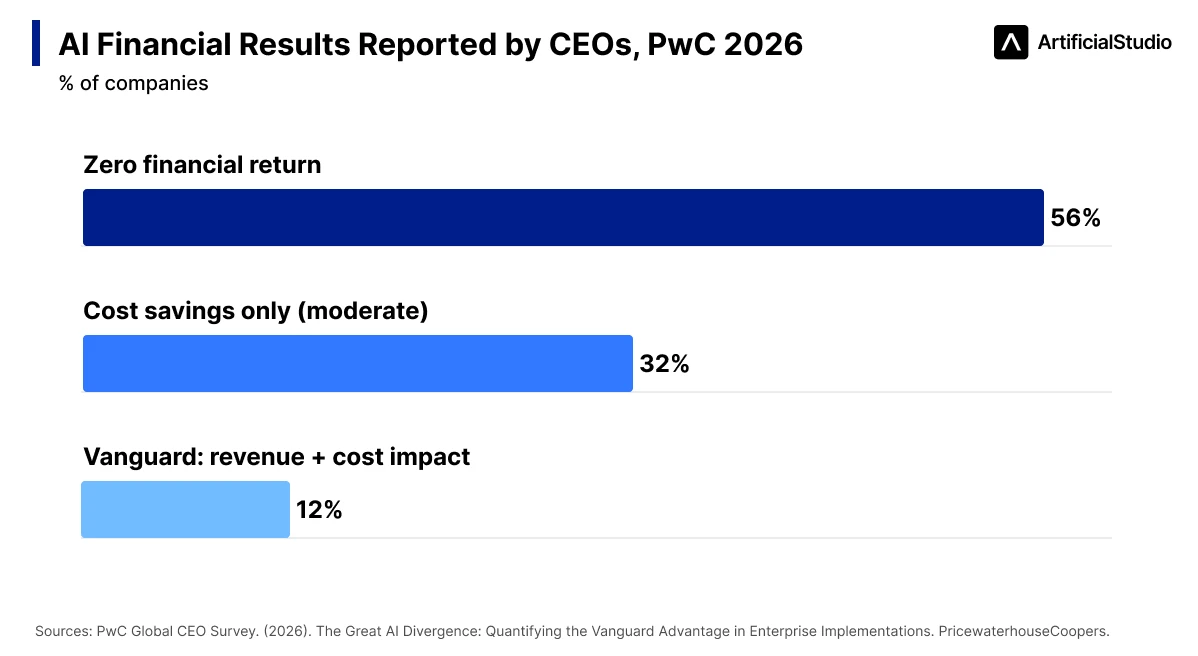
→ PwC reports that 56% of companies see no financial benefit from AI.
→ McKinsey reports that 60% see no measurable business impact.
→ The National Bureau of Economic Research puts it bluntly: roughly 80% of companies see no productivity impact at all.
The first symptom: most AI strategies are theater
Industry observers estimate that roughly 75% of corporate AI strategies are performative.
Companies implement AI tools so the CEO can tell the board the company "is using AI". These initiatives are designed to produce evidence of activity, but in reality:
❗️ There is no defined outcome metric
❗️ No owner with skin in the game
❗️ No timeline beyond "we're piloting it"
If you have all of them, instead of an AI strategy, it is just a budget line item.
The bigger problem: most companies don't even know what they're spending on AI
Ask any CFO how much the company spent on AI last month, and usually they don't know.
The reason is structural. AI spend gets aggregated into the broader "software and SaaS" line in the P&L, alongside cloud hosting, dev tools, and miscellaneous subscriptions. ChatGPT, Claude and Gemini disappear into the same bucket as Google Workspace and AWS.
If you can't see the spend, you can't measure the return.
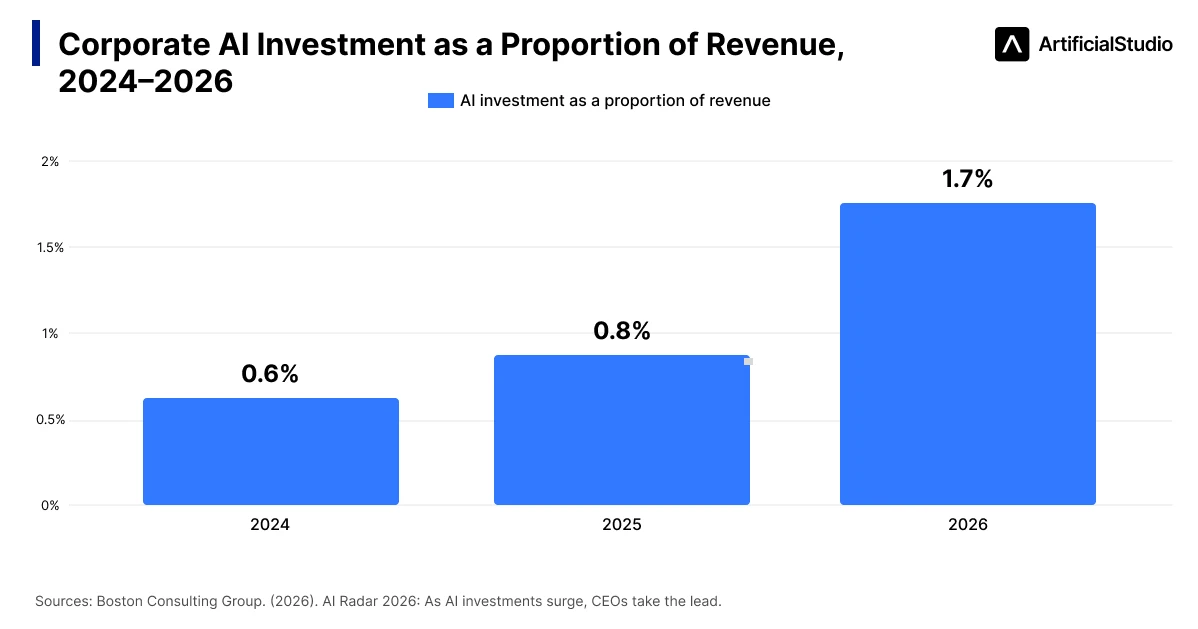
In reality, the spend isn't even that large. Corporate AI investment averages around 1.7% of revenue in 2026, up from 0.6% in 2024. Real growth, but not catastrophic.
A $20/month ChatGPT subscription per employee — across a 2,000-person company — costs about $480,000 a year. Less than the cost of office chairs for the same team.
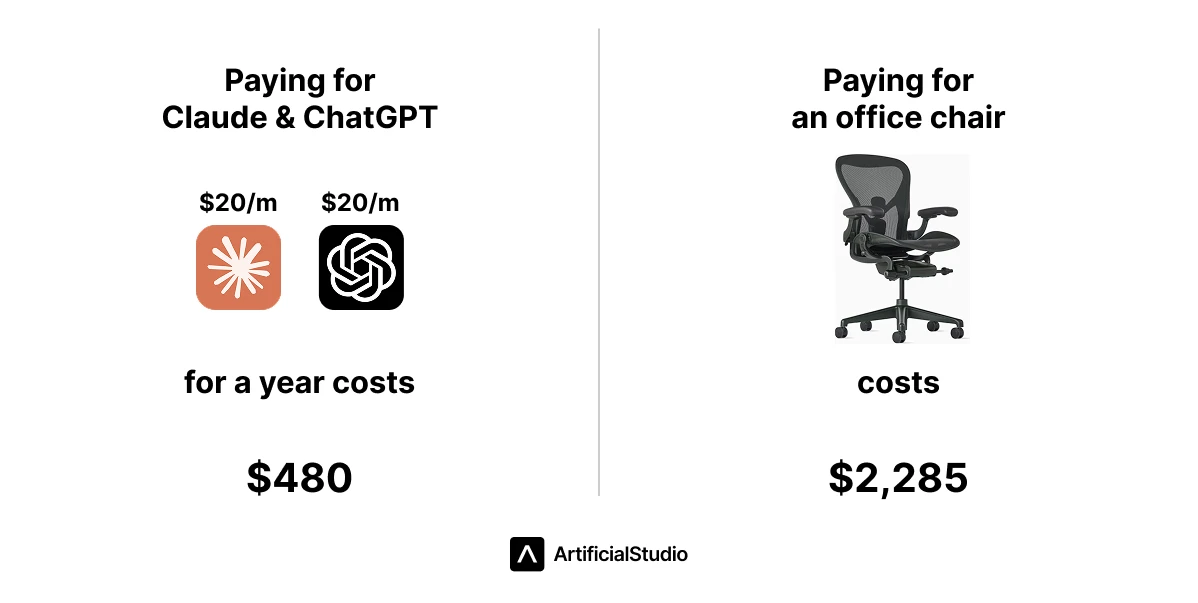
The fear-based response — "we need to cut AI costs before we know what they are" — is what's actually destroying the ROI conversation.
The "invisible gain" pattern: where the value actually shows up
Here's a pattern almost every team experiences but few measure.
Imagine someone from your marketing team. Last month, building a competitive analysis deck took him 12 hours. This month, with AI doing the heavy lifting on the research, it took him 30 minutes.
That 11.5-hour gain is nowhere on the P&L (Profit and Loss statement).
But it does show up in his life and stress level. Now he leaves work at 5 instead of 8. And he has exactly zero incentive to report the gain, because in most companies, reported productivity gains lead to more assigned work, not more rest.
Roughly 56% of AI-driven productivity gains happen at the task level, not the company level. And more than 90% of those gains happen invisibly to management.
The improvements are real. They're just not flowing into any system that measures them.
This is the single most underestimated reason ROI looks like zero — companies are measuring at the wrong altitude.
The wrong owner: HR can't measure AI ROI
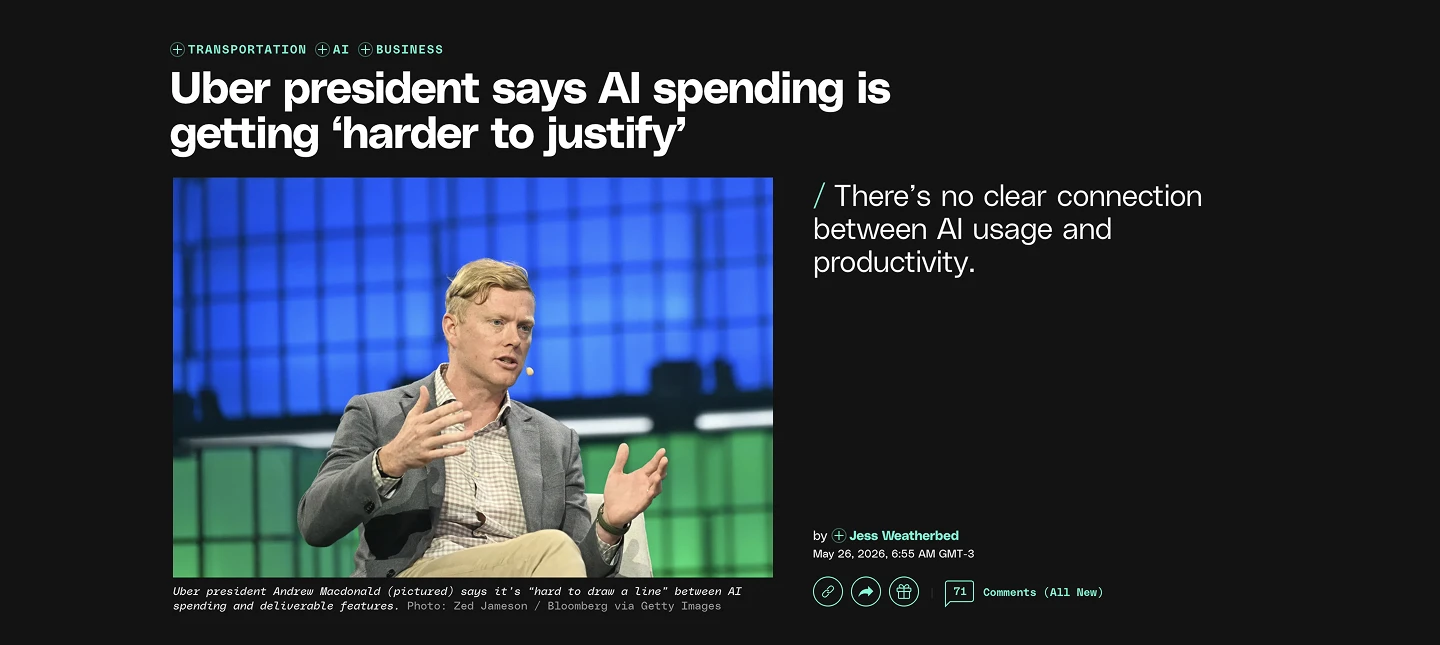
In most companies, AI rollout is owned by HR or IT. Both are the wrong owners.
The reason is structural. The people who measure AI ROI need to own the business metric that AI is supposed to move. HR doesn't own conversion rate and IT doesn't own creative output. Neither owns close rate, ad performance, or campaign velocity.
When HR distributes ChatGPT licenses, the productivity gains show up in marketing, sales, design, and product — but not in HR. HR sees only the cost. And to a CEO reading HR's report, the cost is the only signal that exists. Which leads, predictably, to cuts.
The fix is to put AI ownership inside the team where the business metric lives.
If you want AI to improve creative output, your head of creative owns the measurement. If you want it to improve sales velocity, your VP of sales owns it.
Subscribe to get deep dives on tech and the future of creative work.
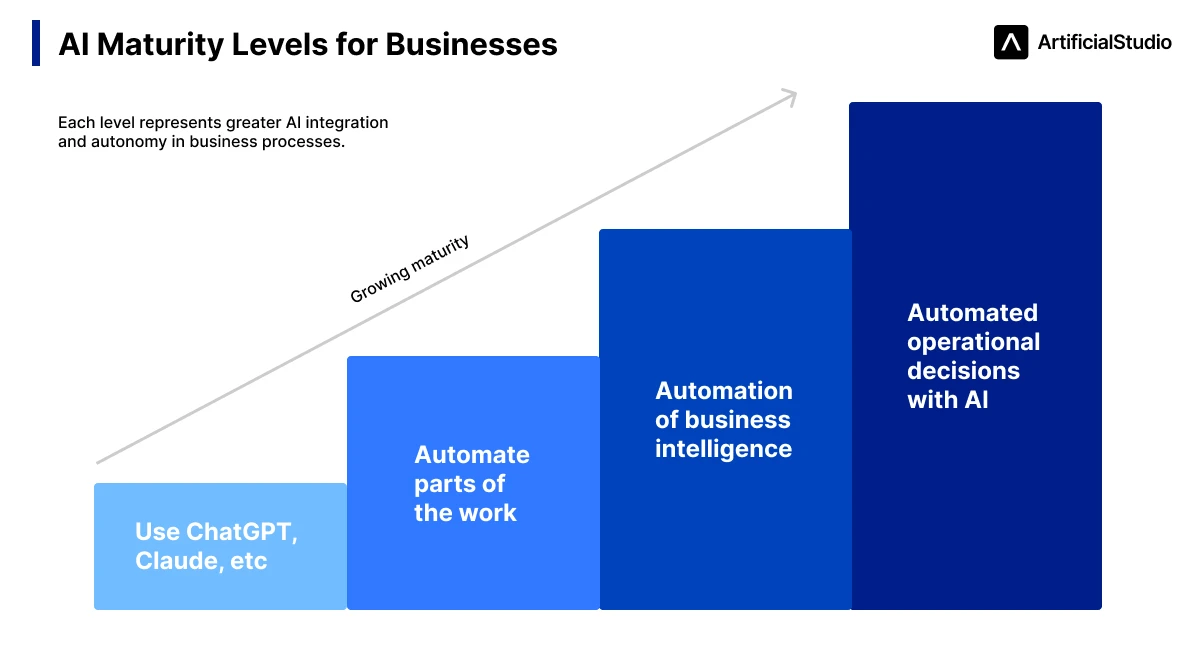
The four stages most companies never climb
Stage 1 — Use the chat.
People type prompts into ChatGPT or Claude when they get stuck. Productivity goes up a little, invisibly. This is where roughly 80% of companies live.
Stage 2 — Automate parts of the work.
Specific **repeatable tasks **(email drafts, content briefs, asset variations, research summaries) become AI-first by default. The team gets faster, and you can finally start measuring the change.
Stage 3 — Automate the business intelligence layer.
AI doesn't just produce work, it answers questions about the business. "Which campaigns are underperforming and why?" gets answered by an AI agent with access to the data, not by a three-hour meeting.
Stage 4 — Agentic operations.
AI systems take actions on their own within defined boundaries — running campaigns, generating creative variants, qualifying leads, adjusting budgets. Humans set strategy and approve direction.
The jump from Stage 1 to Stage 2 is where most teams get stuck. They've adopted the tools but never restructured the work. So the gains stay at the individual level and never become company-level results.
The cheap-model trap
A piece of bad advice circulating in 2026:
"cut AI costs by using only the cheapest model available."
This is one of the most expensive mistakes a team can make.
Cheap models are cheap because they're less capable. If you use the cheapest available model to do strategic work: drafting brand positioning, building a campaign concept, analyzing a market; you'll get cheap-grade output. The cost saved on tokens gets paid back many times over in the quality of decisions made downstream.
The right model for a task is the cheapest one that still meets the quality bar — not the cheapest available. For some tasks (bulk image edits, transcriptions, basic summaries), the cheapest model is perfect. For others (strategic analysis, brand-level creative direction, anything client-facing), it isn't.
This is why teams built around a single model leave so much value on the table. The ones that win are the ones that can pick the right model for each specific job, and switch the moment a better one launches. Platforms like Artificial Studio exist for exactly this reason: instead of locking into one model and one workflow, you compare outputs across models in seconds and use whichever delivers what the work actually needs.
What the 5% that wins actually does
Three patterns separate the teams that generate measurable AI ROI from the 80% that don't:
They own a specific business metric and let AI move it.
Not "implement AI" — improve close rate, reduce cost per asset, increase campaign throughput, shrink time-to-publish. The metric exists before the AI does.
They measure at the task level, not just the company level.
They track which workflows got faster, which assets got cheaper to produce, which decisions took less time. Then they roll those task-level gains up into real business outcomes.
They invest in their people, not just their tools.
Buying licenses is the cheap part. Teaching a team to think systemically about how AI fits their workflow, that's the work. Tools without trained people produce theater. Trained people without tools produce frustration. Both together produce results.
Start with one number
If your team is somewhere in the 80% that can't measure AI ROI, here's the cheapest possible way to start 👇
1. Pick one business metric that matters to your team and measure it for one month without changing anything.
A real business outcome, like conversion rate, time-to-publish, cost per creative asset, qualified leads per week.
2. Then make one deliberate AI-driven change and measure the same metric again.
Automate a step, replace a workflow, swap a manual review for an AI-assisted one.
That's the whole framework. The teams that win at AI are doing some version of this with discipline. AI didn't fail at your company. The measurement did. And that's a problem you can fix this week 😎
Try it yourself
Start creating with the tools mentioned in this article.