Why companies are rehiring the workers AI replaced.
Ford, Klarna and IBM learned the hard way that AI replaces workflows, not people. Here's what creative teams and agencies should do differently.
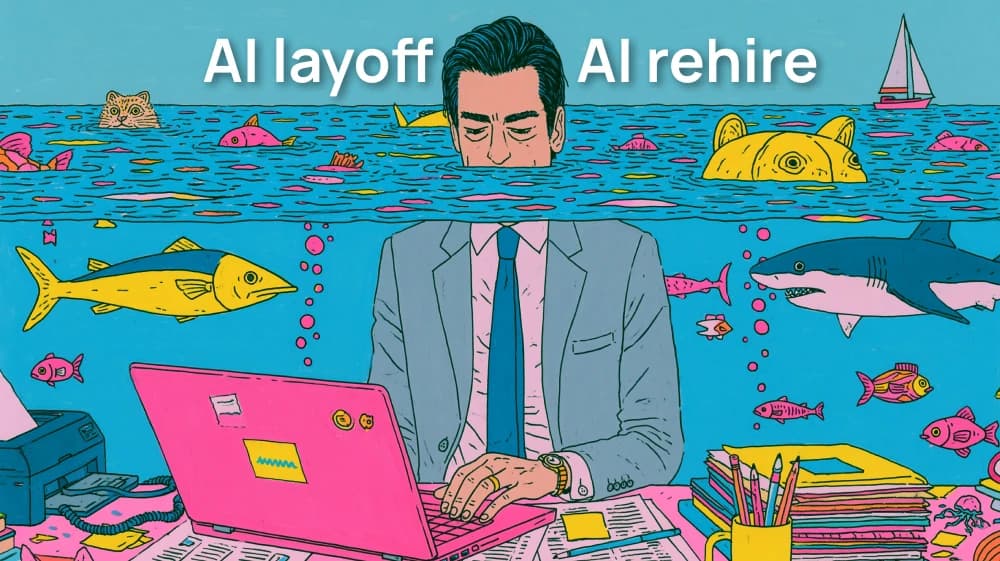
Until last year, much of the tech industry believed they could replace people with AI, cut costs, and then get the work done faster and cheaper.
Today, some of the world's largest companies are quietly rehiring their employees.
The rehiring wave is expensive.
The Ford company spent three years hiring back 350 veteran engineers after leaning too hard on automated quality systems that couldn't deliver the results promised.
Ford's VP of vehicle hardware engineering told reporters:
"Mistakenly we thought that by just introducing artificial intelligence and ingesting the design requirements that we had, that that would produce a high-quality product"
The returning engineers (internally nicknamed the "gray beards") now hunt for failure points before parts ever reach the plant floor, mentor junior staff, and reprogram the very AI tools that were meant to replace them.
Ford expects the correction to cut roughly $1 billion in costs this year 💸
This summer, it took the top spot among mainstream brands in the J.D. Power Initial Quality Survey for the first time in sixteen years (TechCrunch).
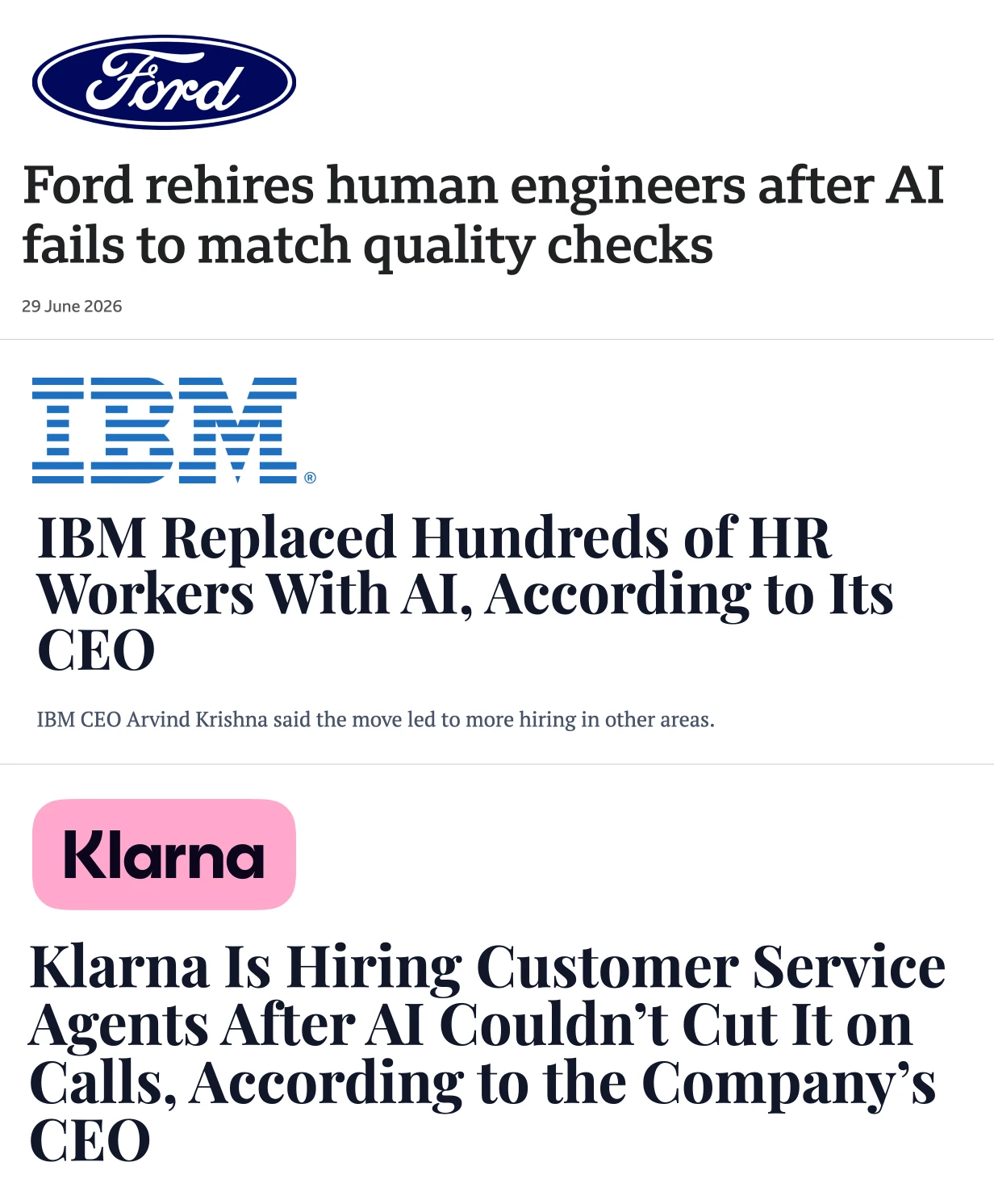
Klarna, the digital bank, in early 2024 the fintech boasted that its AI assistant was doing the work of 700 customer service agents and handling 2.3 million conversations a month.
By May 2025, CEO Sebastian Siemiatkowski was walking it back publicly, admitting the cost-cutting had gone too far and left the company with "lower quality" service. Klarna is now rebuilding its human support team around a simple promise: there will always be a person to talk to if you want one
Even IBM, often cited as the big example for AI-driven headcount cuts, have this problem. Its AskHR agent automated roughly 94% of routine HR tasks and displaced a few hundred roles.
But CEO Arvind Krishna was clear that IBM's total employment went up, because the money freed by automating rote work got reinvested into software engineers, salespeople, and marketers. What he called "critical thinking" roles where humans work with and against other humans
Subscribe to get deep dives on tech and the future of creative work.
AI absorbed the repetitive low-judgment work —and when it touched anything that required taste, context, or accountability, the humans came back.
An MIT study published in 2025 through its NANDA initiative found that 95% of enterprise generative-AI pilots delivered no measurable impact on the bottom line.
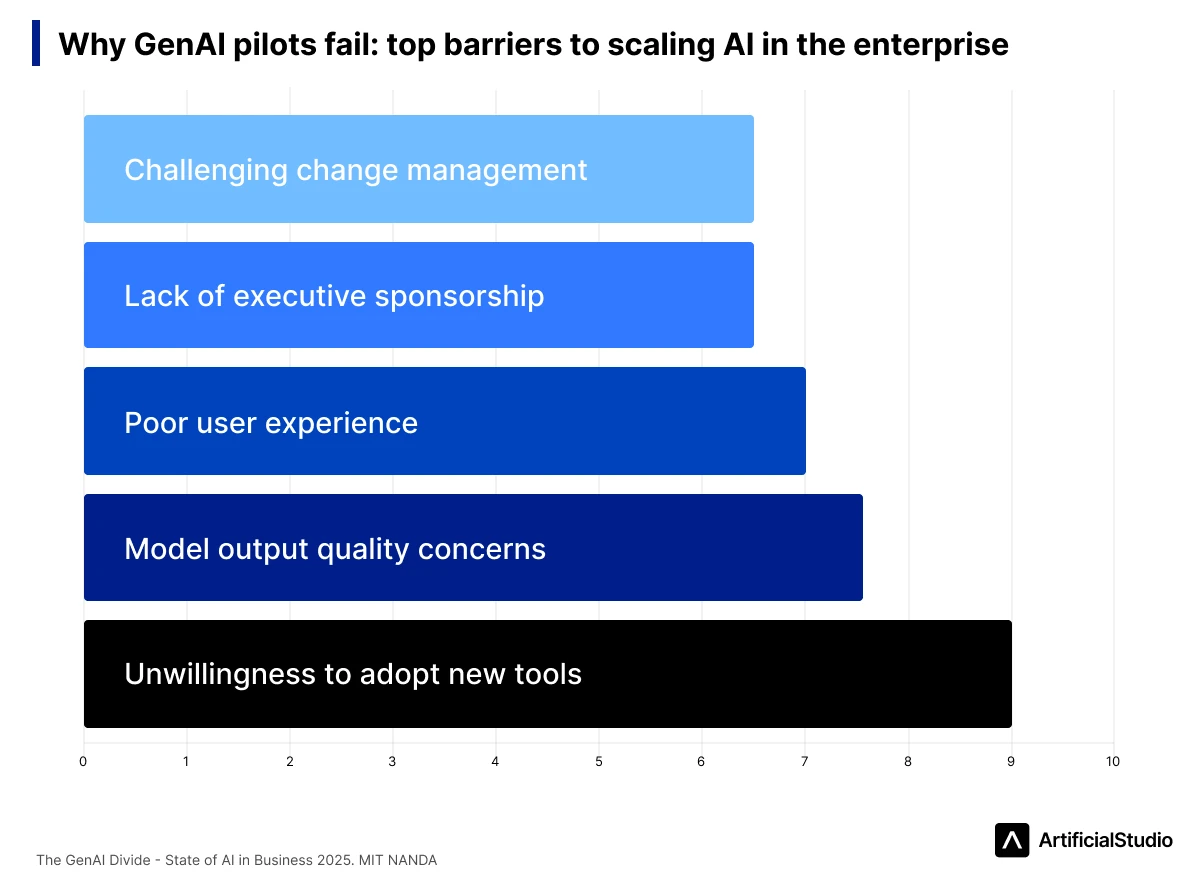
The researchers concluded the failures weren't caused by weak models, they were caused by a "learning gap": tools that don't adapt to real workflows, and organizations that don't integrate them well. Notably, buying from specialized vendors succeeded about 67% of the time, while internal build-it-yourself projects succeeded at roughly a third of that rate.
Creative teams can't ignore this
For anyone in design, video, branding, or content: Audiences can tell. And they don't like being handed something that no human seemed to care about.
Don't make the same mistake as Ford and Klarna. Unsupervised, generic AI output has a texture (people have started calling it "slop") and it reads as nobody was home. That's poison for a brand.
That does not mean that AI-generated visuals are worthless. It means that AI-generated content, without human creative direction, has far lower performance and quality.
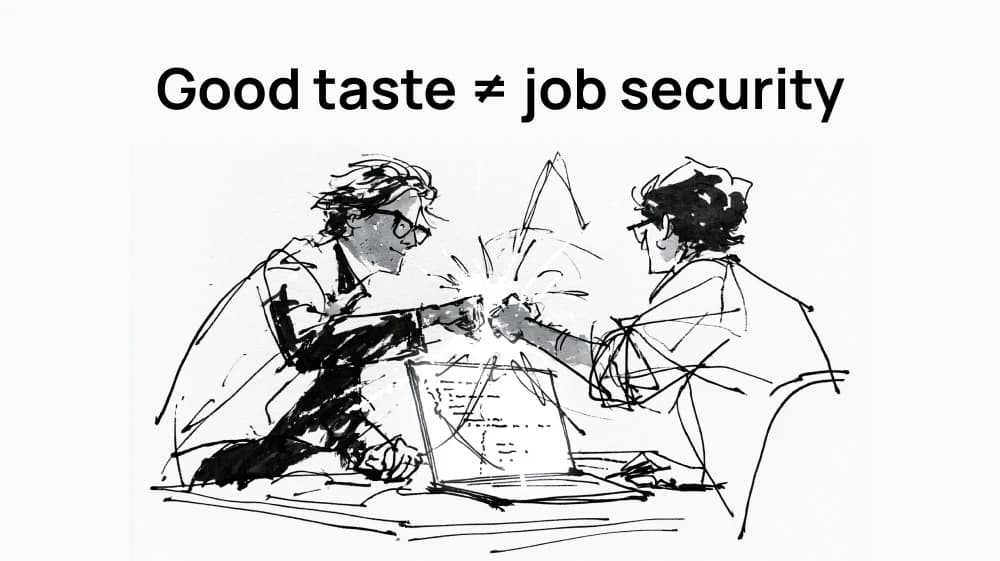
The differentiator is the person with taste sitting on top of the tool: choosing, refining, rejecting, and shaping raw generations into something that actually lands. Remember: less time on the mechanical execution, more on the judgment.
Amplify, don't replace
Don't fire your creatives, and don't refuse to touch AI either. Do what IBM did: use automation to clear the rote work so your best people can spend more time on the parts only people can do.
For a creative agency, that looks like AI handling the first eighty percent, so your team spends its hours on direction, concept, and the final ten percent that clients actually pay for. For a freelancer, it means saying yes to briefs you'd have had to turn down or subcontract, because the production grunt work no longer eats your week.
Amplify the people whose taste is the reason clients hire you in the first place.
If you want a production stack built around that idea, AI that handles the heavy lifting across video, images, branding, audio, and 3D while your team stays in the director's chair, that's exactly what Artificial Studio is for.
Try it yourself
Start creating with the tools mentioned in this article.